

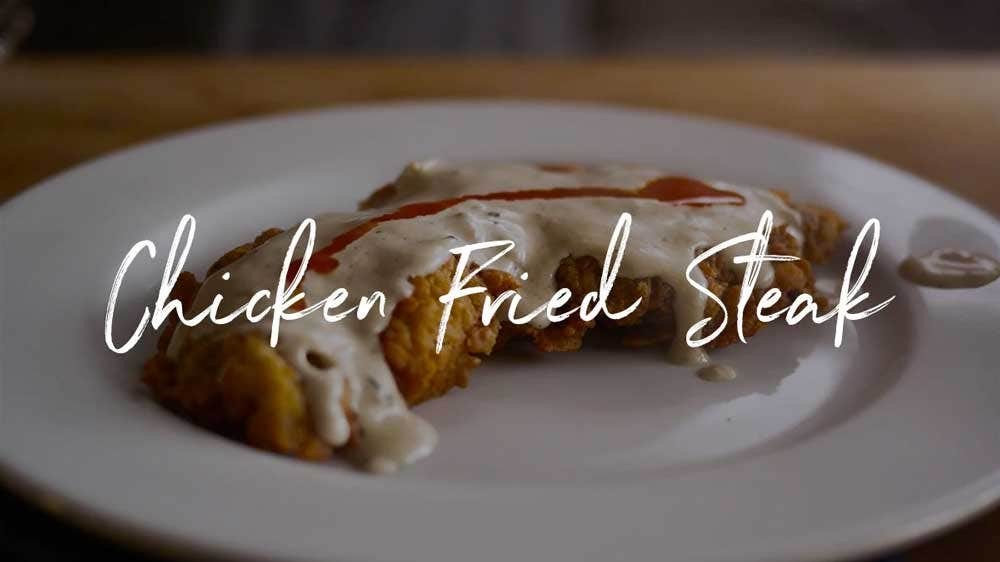
Bring elevated comfort food to your table with Chef Tom's Chicken Fried Steak recipe! Fried in Lodge cast iron over a wood fire in the Yoder Smokers Pellet Grill, this home-style classic is sure to have your guests asking for seconds.
WHAT YOU'LL LOVE
- Pounded, dimpled steak: Flattening lean eye of round to 1/2" and denting it with the studded side of the mallet tenderizes the meat and gives the coating more to grip.
- Double dredge: Flour, then buttermilk and egg spiked with hot sauce, then flour again builds a thick, craggy crust.
- Rest before frying: Letting the coated steaks sit on a wire rack lets the flour hydrate so the crust stays on in the oil.
- Skillet gravy: A quick roux made in the same skillet, with stock, half-and-half, garlic, and thyme, turns the browned bits into a creamy sauce.
Chicken Fried Steak
Tom Jackson
Rated 5.0 stars by 1 users
Category
Entree
Cuisine
American
Servings
4
Prep Time
30 minutes
Cook Time
40 minutes
Calories
1201
Chef Tom shares his take on the home-style classic, Chicken Fried Steak. Fried in Lodge cast iron over a wood fire in the Yoder Smokers Pellet Grill, it’s comfort food, elevated!
Ingredients
- 1 1/2 lb beef eye of round or bottom round steaks
- 1 cup buttermilk
- 2 eggs
-
1 tbsp Killer Hogs Hot Sauce
- 2 cups self rising flour
-
2 tbsp R Butts R Smokin’ R Beef Rub
- 1 cup canola oil, for frying
-
Killer Hogs Hot Sauce, for serving
- 1 tbsp butter
- 1 1/2 tbsp flour (self rising is fine, but not required)
- 1/2 cup chicken stock
- 1 cup half-and-half
- 1 clove garlic, crushed
- 1 sprig fresh thyme
-
Noble Saltworks Hickory Smoked Salt
- Black pepper
For the gravy:
Directions
Preheat your Yoder Smokers YS640s Pellet Grill to 425ºF set up with direct and indirect grilling zones.
- Divide the beef into 4 equal sized steaks. Using the flat side of a meat mallet/tenderizer, pound the meat out until about 1/2” thick. Using the studded side of the mallet, pound gently to create divots on the surface.
Whisk together the buttermilk, eggs and Killer Hogs Hot Sauce. Place in a wide shallow container.
Place the flour and R Butts R Smokin’ R Beef Rub in another shallow pan, and mix well.
Set up a wire rack over a sheet pan.
- Dredge each steak in the seasoned flour, pressing the flour firmly into the meat. Shake off the excess flour and transfer to the buttermilk mixture. Coat the entire surface then remove the steak. Let the excess buttermilk drip off before transferring back to the seasoned flour. Again coating the entire surface and pressing the flour in firmly. Transfer each of the steaks to the wire rack and allow them to sit for about 1-15 minutes, until the flour is moistened.
Place a Lodge 12” Cast Iron Skillet directly over the flame, inside the grill. Add about one cup of canola oil. Close the door and allow the oil to heat up to about 400ºF.
- Carefully lay each steak in the hot oil. You should be able to cook two steaks at a time. Cook with the door open until golden brown on the bottom. Flip and continue cooking until the opposite side is golden brown. Remove from the oil and place on a clean cooling rack over a sheet pan, placed on the far right side (indirect zone) of the grill.
Using an instant read digital thermometer, monitor the temperature of the oil as you are frying. If it dips below 325ºF during the cooking process, close the lid and allow the oil to get back into the 325ºF-375ºF range.
- When all four steaks are finished, carefully pour the hot oil out of the skillet, into a heat-resistant container. Return the skillet to the direct side of the grill and make your gravy.
Melt the butter in the skillet. Add the flour and whisk until slightly browned and putting off a nutty aroma, about one minute. Slowly pour the chicken stock into the skillet, whisking constantly. Slowly pour the half-and-half into the skillet, whisking constantly. Add the garlic and thyme. Bring the gravy to a simmer. Simmer until thickened to desired consistency, about 5 minutes. Add Noble Saltworks Hickory Smoked Salt and fresh ground black pepper, to taste.
Serve the Chicken Fried Steak topped with the creamy gravy and a dash of Killer Hogs Hot Sauce.
Recipe Note
Recipe FAQ
Why use eye of round or bottom round for chicken fried steak?
Both are lean, affordable cuts that are tough when cooked whole. Pounding them thin and frying quickly turns them tender enough to eat with a fork.
Why pound the steaks and then dent them with the studded side of the mallet?
Flattening them to about 1/2" thick makes them cook quickly and evenly, and the gentle denting breaks up the muscle fibers and gives the flour coating small grooves to hold onto.
Why dredge the steaks twice?
Dipping in the seasoned flour, then the buttermilk mixture, then the flour again builds a thick, craggy crust that stays crisp and holds the gravy.
Why let the coated steaks rest on a wire rack before frying?
A short rest lets the flour absorb the buttermilk and turn into a paste on the surface, which helps the coating stay on in the hot oil instead of sliding off.
Why monitor the oil temperature while frying?
Oil that dips below 325°F makes the crust greasy, and oil that climbs well above 375°F can burn the coating before the steak cooks. Closing the lid between batches helps the oil recover its heat.
Why fry only two steaks at a time?
Frying in small batches keeps the oil from cooling too much and gives each steak room to brown evenly.
Why hold the fried steaks on a wire rack in the indirect zone?
A rack lets air circulate under the steaks so the bottoms stay crisp instead of steaming on a flat surface, and the indirect zone keeps them warm while the gravy is made.
Why cook the flour in butter before adding the liquid?
About a minute of whisking until the flour turns slightly darker and smells nutty cooks out the raw flour taste and gives the gravy a richer flavor.
What internal temperature should the steaks reach?
This recipe doesn't state one. Whole-muscle beef is safe at 145°F with a 3-minute rest. Because these steaks are tenderized with a studded mallet, check the thickest part with an instant-read thermometer rather than relying on color.
How do I handle the hot oil safely?
Keep the oil in the skillet from overheating, never leave it unattended over the flame, and let the oil cool before discarding. Pour it into a heat-resistant container, as the recipe directs, rather than down the drain.
How indoor-friendly is this recipe?
5 out of 5. A cast iron skillet on the stovetop fries these the same way, and the gravy is made in the same pan.
Recipe Highlights
Pounded and dimpled steak: Tenderizes lean beef and helps the crust cling.
Double dredge: Builds a thick, craggy crust.
Rack rest before frying: Helps the coating stay on.
Same-skillet gravy: Turns browned bits into a creamy sauce.
Recommended Recipes
Nutrition
Nutrition
- Nutrition Serving Size
- 16.22 oz
- per serving
- Calories
- 1201
- Carbs
- 57 grams
- Protein
- 65 grams
- Fat
- 78 grams
- Sodium
- 675 milligrams


