

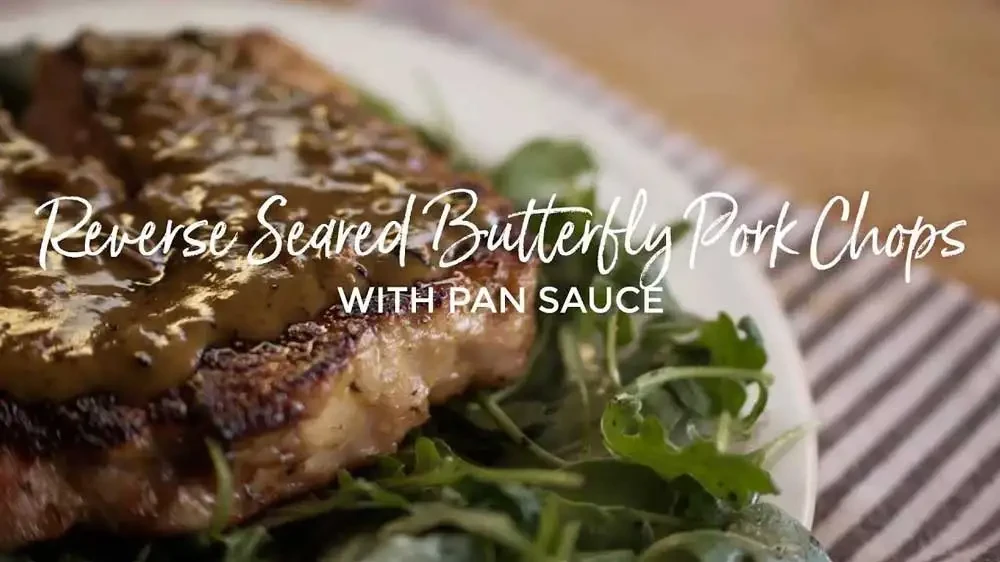
Delight your taste buds with Chef Tom's exquisite recipe for Reverse Seared Butterflied Pork Chops - cooked and served with a tantalizing pan sauce. Savour each bite of this flavourful and juicy dish that will leave you wanting more. Delicious!
WHAT YOU’LL LOVE
- Butterflied “double chops”: A 2.5" section of boneless pork loin, with the fat cap removed, is split and opened like a book into one large, even chop, which cooks faster and gives more surface for seasoning and searing.
- Reverse sear: The chops cook gently with peach wood smoke on the second shelf until they reach 120°F, then go straight into a preheated Lodge 10" skillet for a hard sear.
- Binder and steakhouse seasoning: A thin coat of oil or mustard holds Cattleman’s Grill Steakhouse Seasoning on every surface.
- One-skillet pan sauce: Shallots, garlic, and thyme cooked in the browned bits, then white wine, chicken broth, House of Q mustard sauce, cream, and butter, reduce into a silky sauce for the pork.
Reverse Seared Butterflied Pork Chop with Pan Sauce
Tom Jackson
Rated 5.0 stars by 1 users
Category
Entree
Cuisine
American
Servings
2
Prep Time
1 hour
Cook Time
1 hour
Calories
513
Chef Tom cooks up a Reverse Seared Butterflied Pork Chop and then creates a basic pan sauce to serve with it.
Ingredients
- 1 (2.5”) section of boneless pork loin
-
Cattleman’s Grill Steakhouse Seasoning
- 3 tbsp shallots, minced
- 1 tbsp garlic, minced
- 2 sprigs fresh thyme
- 1/2 cup white wine
- 1 cup chicken broth
-
2 tbsp Chile Slinger Fatalii (Substitute)
- 2 tbsp heavy cream
- 1 tbsp unsalted butter
- salt and pepper
Directions
- Remove the fat cap from the pork loin. Divide the loin in half. Slice each half down almost all the way through, but leave intact as one piece. Butterfly the chop out, for one large double chop. Repeat with the other half.
- Rub a small amount of binder (oil, mustard, etc.) on all surfaces of the chops. Season with Cattleman’s Grill Steakhouse Seasoning.
- Prepare your Napoleon P500 RSIB-1 for both direct and indirect grilling. Place a smoke box on top the sear plates covering the burners on one end of the grill. Turn on just the burner below the smoke box. Add Cattleman’s Grill Peach Wood Chips to the box and close the lid.
- When the smoke box begins to produce smoke, place the chops on the second shelf, on the opposite side of the grill.
- On the side burner, preheat a Lodge 10” cast iron skillet over medium heat. When the internal temperature of the pork chops reaches 120ºF, open the lid of the grill, turn the burner inside the grill off, and one at a time, sear the pork chops in the hot skillet. Set the chops aside, loosely covered with foil.
- Turn the heat down to medium/low. Add the shallots to the skillet. Cook, moving with a wooden spoon and starting to scrape up some fond. When the shallots are translucent add the garlic and thyme. Continue cooking and stirring another 30 seconds.
- Deglaze with white wine. Stirring and reducing until the liquid is almost gone. When the wine is nearly gone, add the chicken broth. Bring to a simmer. Add the House of Q Slow Smoke Gold Mustard Sauce. Reduce by half. Add the heavy cream and butter, stirring constantly. Cook to desired consistency. Taste and adjust seasoning with salt and pepper, as desired.
- Remove the sprigs of thyme. Serve the sauce on top of the pork chop.
Recipe Note
Recipe FAQ
Why butterfly the pork loin?
Splitting each half of the loin almost through and opening it out makes one wide, thick chop. It cooks more evenly than a tall roast and gives you more browned surface for the seasoning and sear.
What does reverse sear mean?
Instead of searing first, you cook the pork gently with indirect heat until it's close to done, then sear it at the end. That gives an evenly cooked center and a fresh, crisp crust.
What internal temperature should the pork reach?
Pork is safe at 145°F followed by a 3-minute rest. This recipe pulls the chops at 120°F for the sear, and a quick sear raises the temperature only a little. Check again after searing, and return the chops to the grill or a 300°F oven if they're below 145°F.
Why remove the fat cap?
Loin fat caps can be thick and chewy. Trimming it gives a leaner chop that takes seasoning on every side.
Why use a binder before seasoning?
A thin coat of oil or mustard helps the seasoning stick to the pork and promotes browning in the skillet.
Why make the sauce in the same skillet?
The browned bits left by the seared pork are packed with flavor. Scraping them up with the wine builds the sauce's base.
Why reduce the wine until it's almost gone?
Cooking the wine down removes its alcohol and sharpness and concentrates its flavor, so the sauce tastes rich instead of boozy.
Why add the cream and butter at the end?
Stirring them in last, over gentle heat, makes the sauce smooth and glossy. Boiling it hard can make the sauce separate.
How long should the pork rest?
Let it rest loosely covered for at least 3 minutes, which is also the required rest time for pork, before slicing or serving.
How should I store leftovers?
Refrigerate the pork and the sauce within 2 hours of cooking. They keep for about 3-4 days. Reheat the pork gently and the sauce on low heat.
How indoor-friendly is this recipe?
5 out of 5. A 250°F oven cooks the pork on a rack to 120°F, and a stovetop skillet sears it and makes the sauce. You'd lose the peach wood smoke.
Recipe Highlights
Butterflied chops: Cook evenly and sear well.
Reverse sear: Delivers a gentle cook and a crisp crust.
Peach wood smoke: Adds mild fruit flavor.
Skillet pan sauce: Builds on the browned bits.
Recommended Recipes
Nutrition
Nutrition
- Nutrition Serving Size
- 5.47 oz
- per serving
- Calories
- 513
- Carbs
- 8 grams
- Protein
- 46 grams
- Fat
- 28 grams
- Sodium
- 1250 milligrams


