

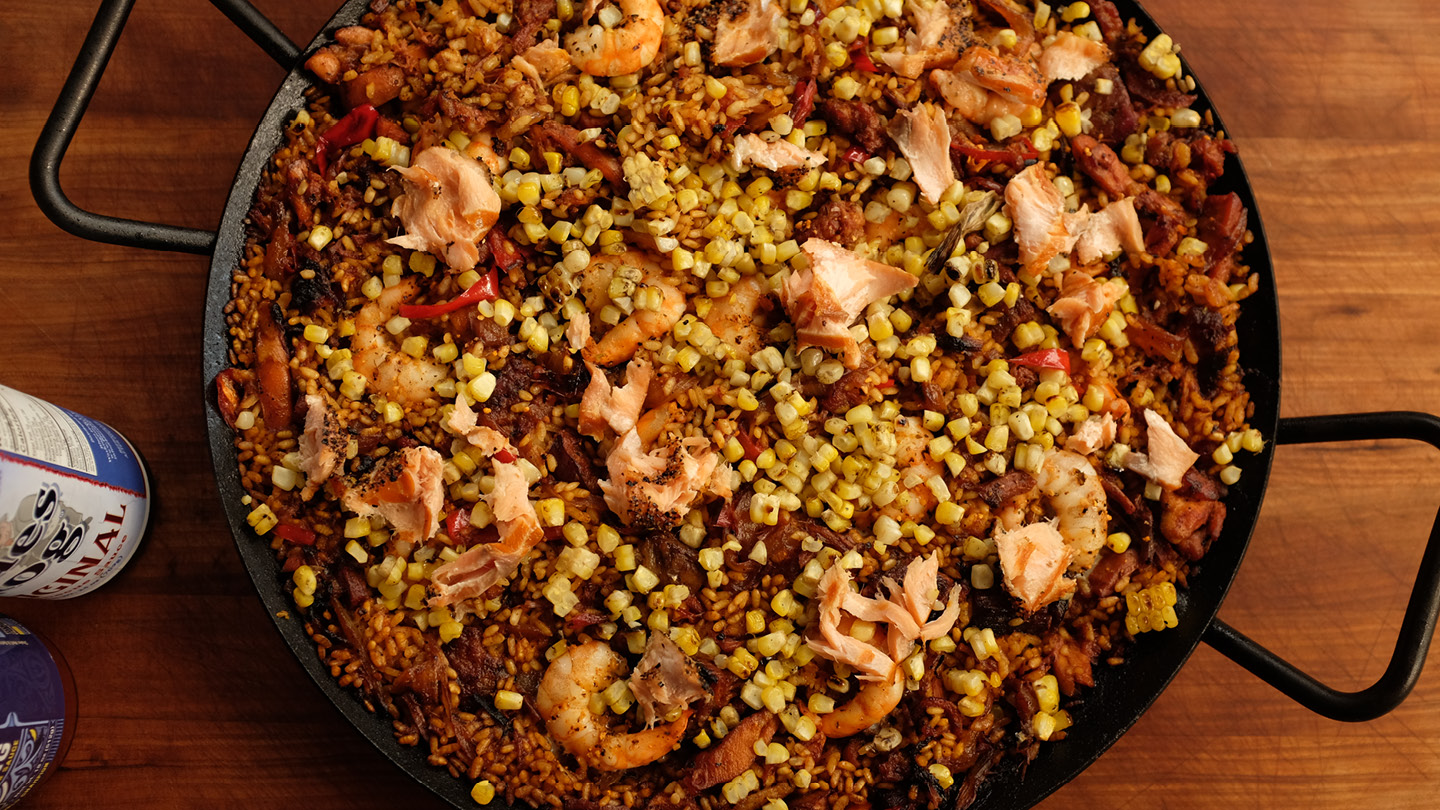
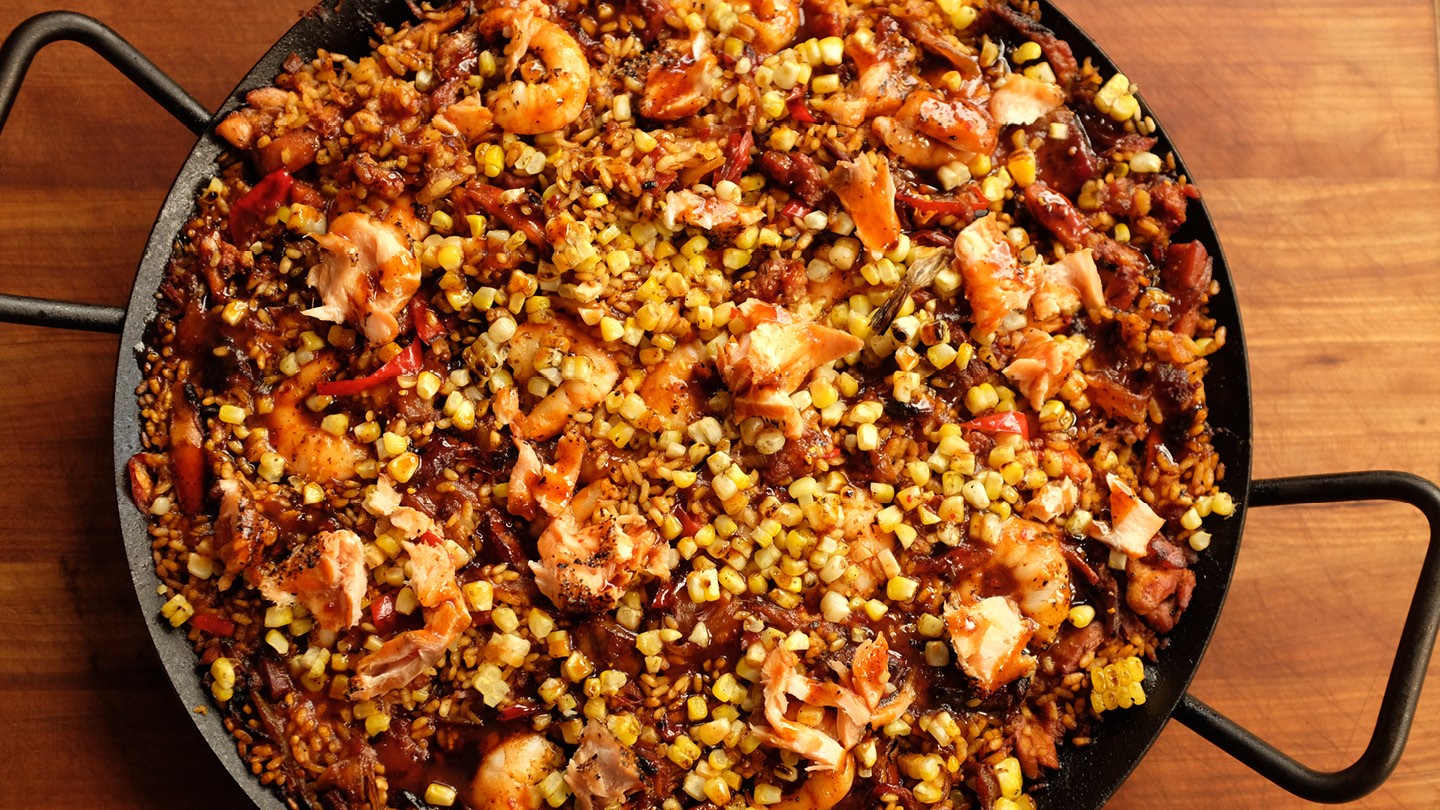
Chef Tom showcases his culinary ingenuity by fusing together classic American BBQ with traditional Spanish Paella to create Barbecue Paella. He shows us how to use leftovers of your favorite BBQ meats and combine them with stock, vegetables, and rice for a one-pan crowd-pleaser. There is something new in every bite of this Barbecue Paella.
WHAT YOU'LL LOVE
- This is the most versatile recipe in the November 2023 ATBBQ catalog — the "2 cups leftover BBQ meat" is intentionally open-ended. Brisket, pulled pork, burnt ends, smoked sausage — any combination works, and the paella absorbs and expresses each differently.
- The socarrat (crispy rice crust on the bottom) is the goal, not an accident. Direction Step 8 removes the lid and cooks at the end specifically to form it — that caramelized, slightly chewy crust is why authentic paella is cooked uncovered over direct fire rather than simmered on a stovetop.
- The dual BBQ sauce finish — one vinegar-forward, one sweet — mirrors the Spanish sofrito tradition of layering acid and sweetness at the end of the cook. The Tarheel Tang's acidity and Blues Hog's sweetness together approximate what saffron and pimentón do in a traditional paella.
- The YS Adjustable Charcoal Grill's split-zone setup runs all three cooking modes simultaneously: direct-heat corn charring, indirect chicken smoking, and direct-heat paella searing — one fire, three techniques at once.
Barbecue Paella
Tom Jackson
Rated 4.8 stars by 8 users
Category
Beef
Cuisine
Spanish
Servings
12
Prep Time
25 minutes
Cook Time
1 hour
Calories
499
Add smokey leftover barbecue meats of many kinds with the rich tradition of Spanish Paella and what do you get? This results in a tantalizing Barbecue Paella. Each bite of Chef Tom’s culinary creativity of Barbecue Paella promises to be a delightful surprise in your mouth.
Ingredients
- 8 cups chicken stock
- 4 cloves garlic, smashed, peeled
- 1 ear corn on the cob
- 1 lb Chicken thighs, boneless, skinless
-
Plowboys BBQ Yardbird BBQ Rub
-
2 tbsp beef tallow
- 1/2 lb raw smoked sausage
- 4 cups yellow onions, sliced
- 2 cups sweet red peppers, sliced
- 2 cups leftover bbq meat (brisket, pulled pork, etc.)
- 1 cup beer
- 2 cups Bomba (or Arborio) rice
- 1 1/2 cups Ciao San Marzano Tomatoes
- 12 oz shrimp, peeled, deveined, tails off
-
Cattleman’s Grill Provisioners Blend Fish Seasoning
- 4 oz smoked salmon
-
Plowboys BBQ Tarheel Tang Carolina BBQ Sauce
-
Blues Hog Original BBQ Sauce
Directions
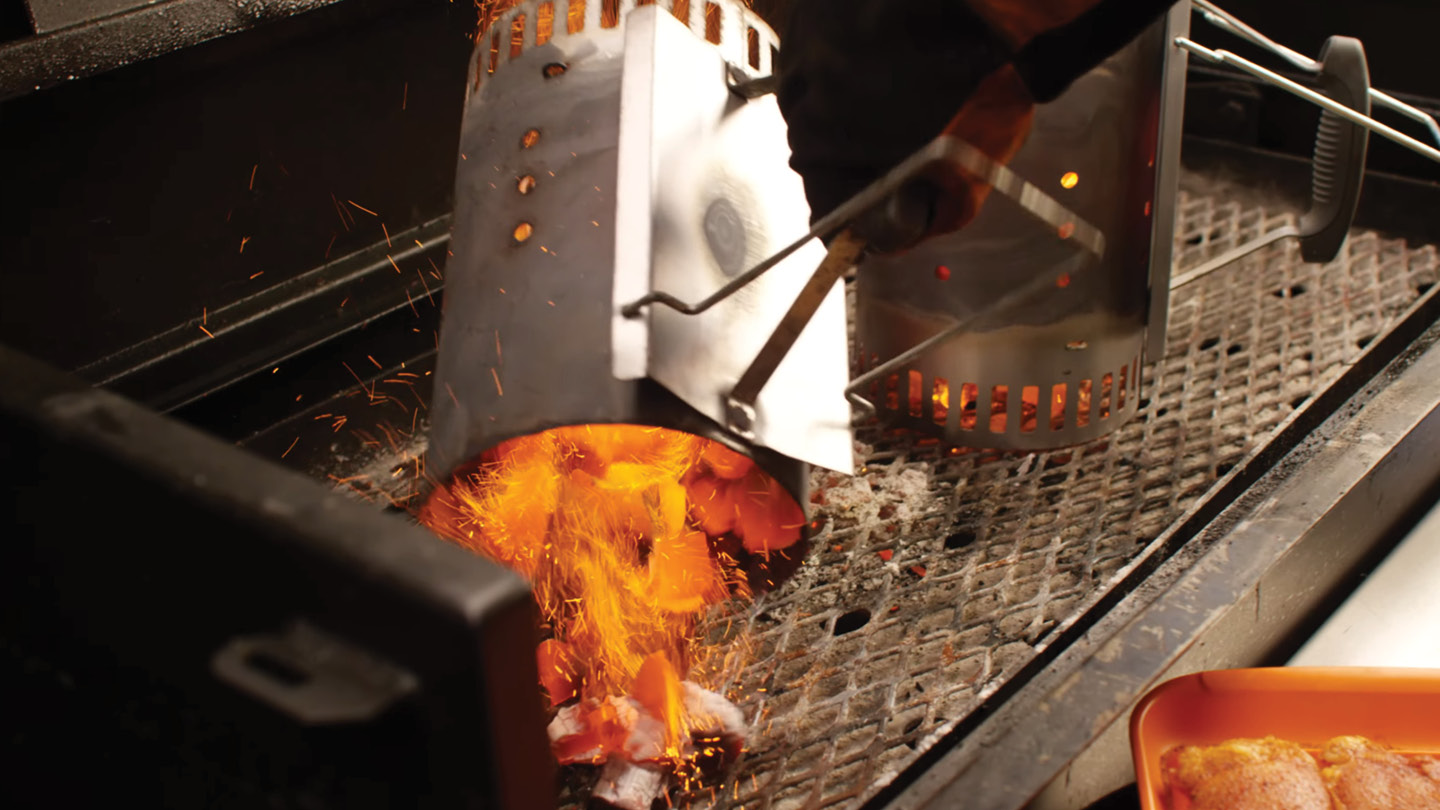
- Light two chimneys filled with lump charcoal in the burn grate of the Yoder Smokers Adjustable Charcoal Grill. When the charcoal is all hot, dump both chimneys on one half of the grill, leaving the other half empty for indirect cooking.
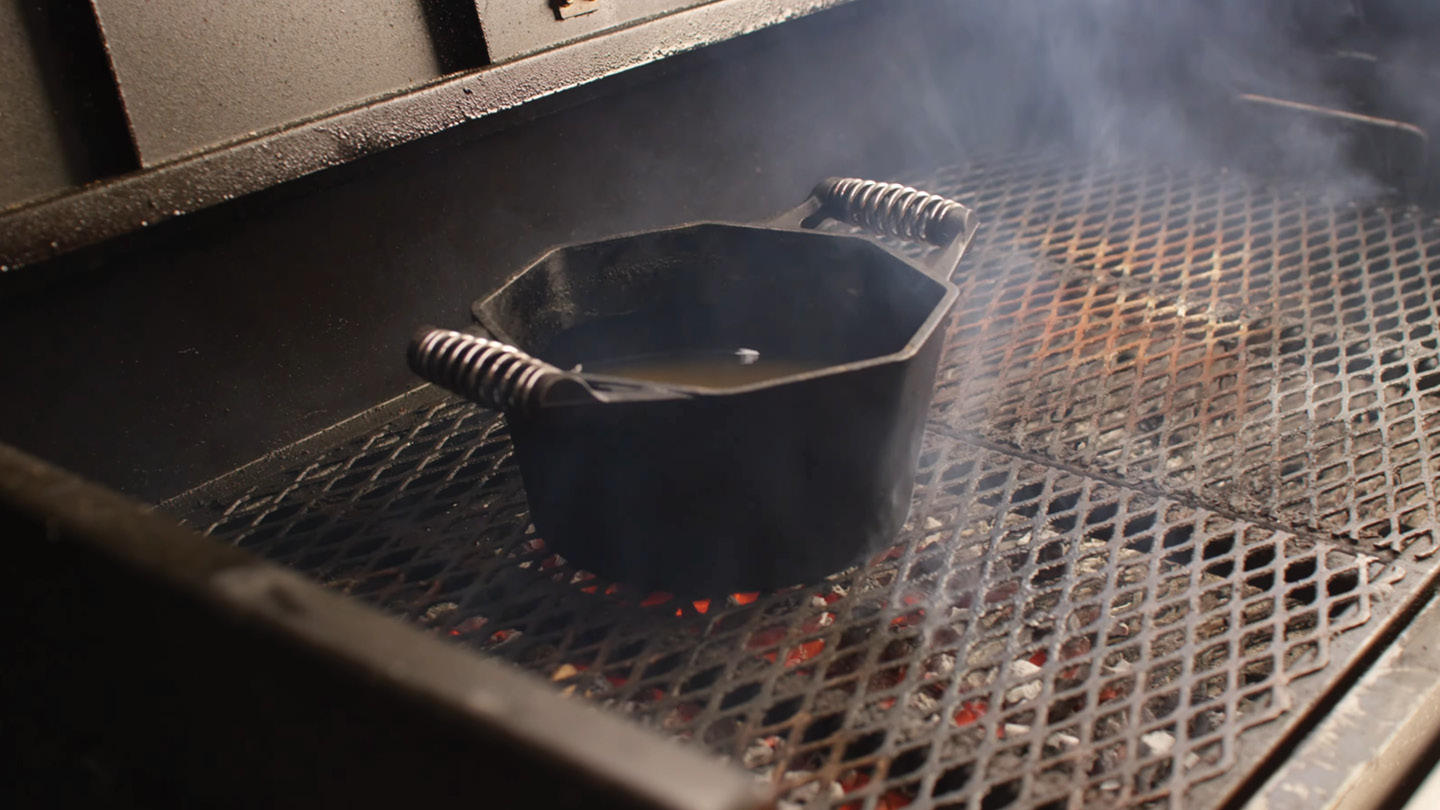
- Combine the chicken stock and garlic in a dutch oven. Place directly over the coals.
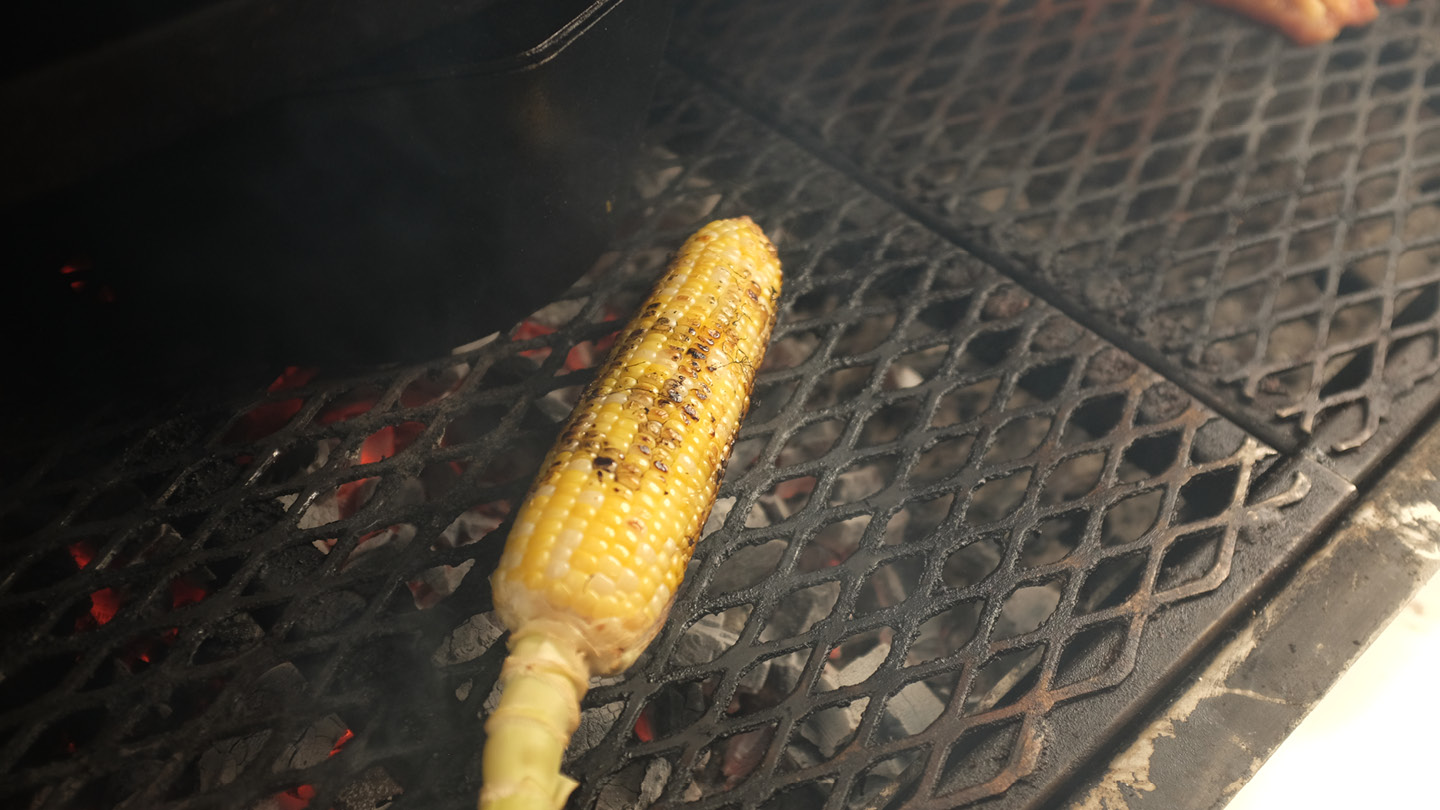
- Grill the corn directly over coals until lightly charred on all sides. Remove. Let cool slightly, then slice the kernels off of the cob.
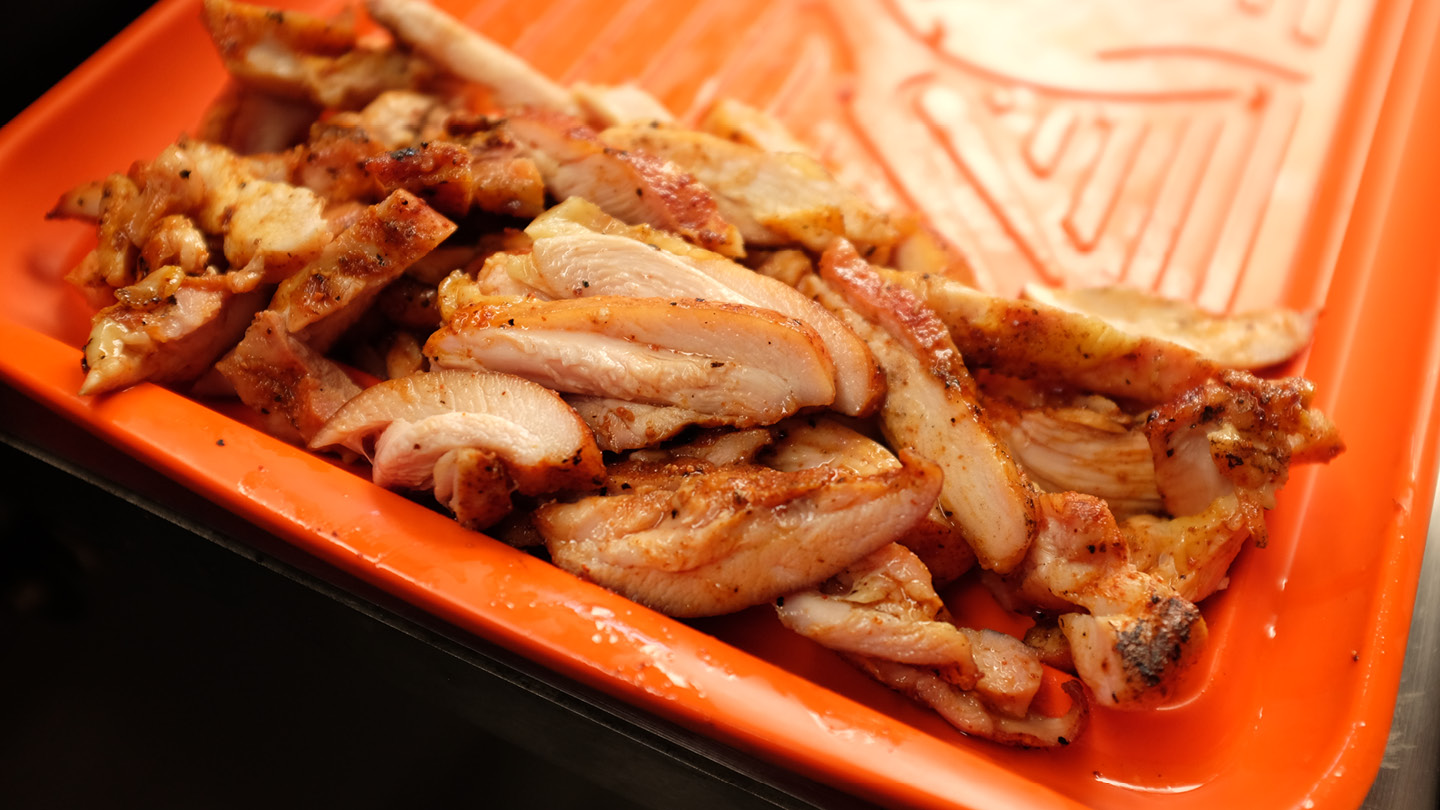
- Season your chicken thighs with Plowboys BBQ Yardbird BBQ Rub. Place a chunk of smoking wood on the hot coals. Place the chicken thighs on the indirect side of the grill (opposite the hot side). Smoke for about twenty minutes. The chicken doesn’t not need to cook all the way through, just enough to get some smoke. Remove and slice into strips.
- Dice the raw smoked sausage. Brown in a Lodge 15” steel skillet over direct heat (directly above the coals). Add the beef tallow to the skillet and let melt, then add the onions and peppers and season with Plowboys BBQ Yardbird BBQ Rub. When the peppers and onions are softened and browning at the edges, add the sliced chicken and leftover barbecue meat. Cook a few minutes more to cook the chicken through.
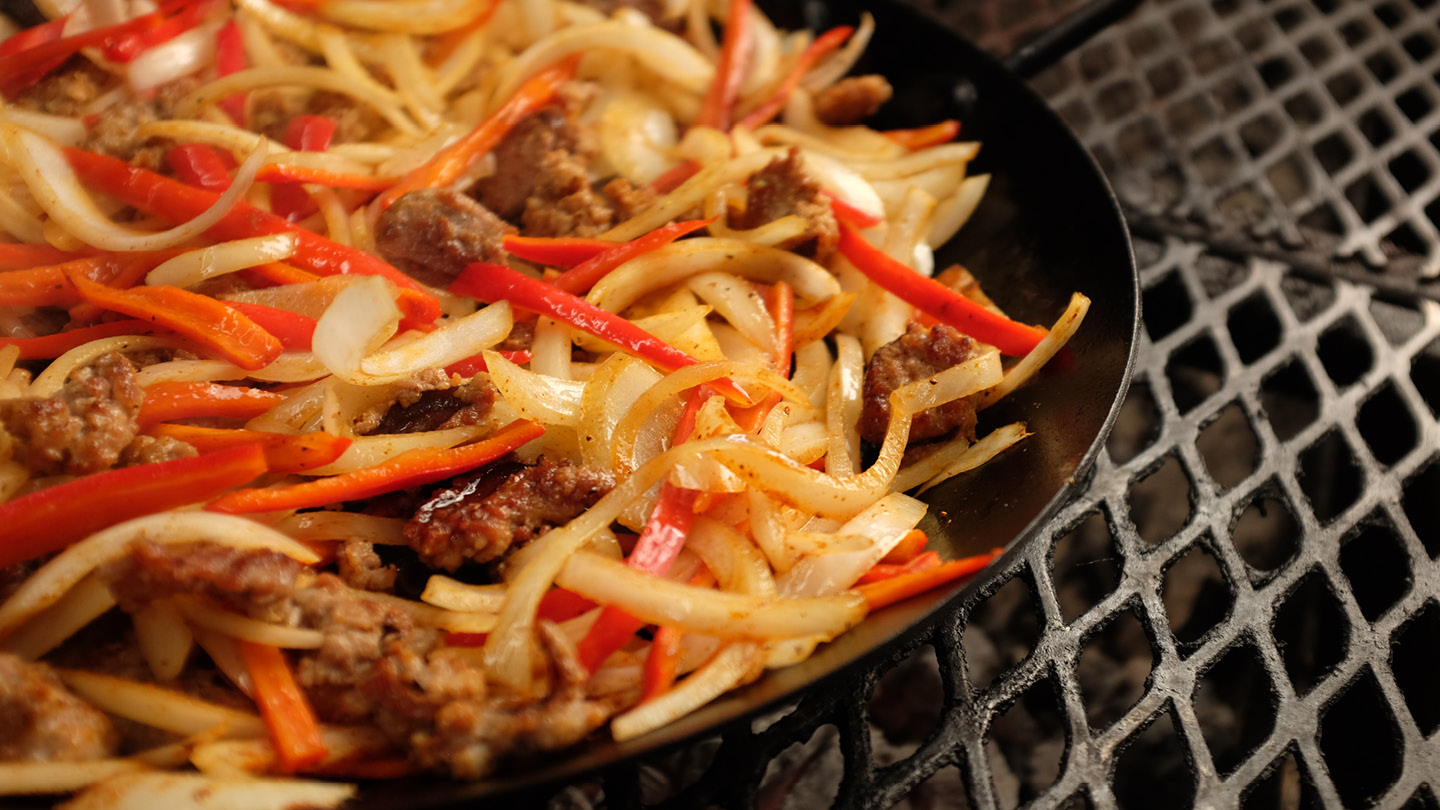
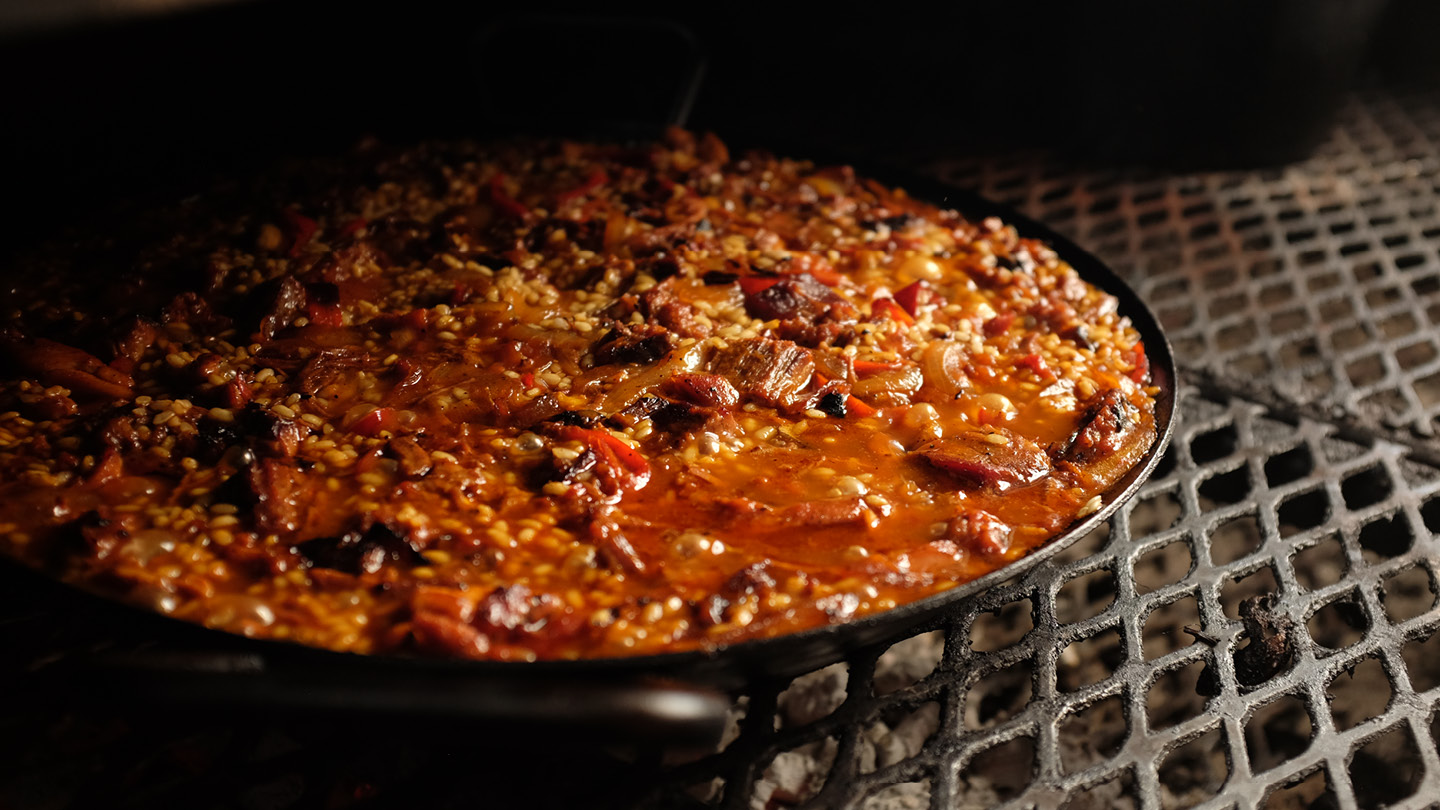
- Add the beer and tomatoes. Chop up tomatoes. Bring to a simmer and let cook for a few minutes. Add the bombs rice and pour hot chicken stock into the skillet (you don’t have to add all of it at once, just enough to fill the pan mostly full). Cook for about 8-10 mintues, until most of the stock is cooked out, then add more chicken stock. Cook until the rice is almost tender, about 15-18 minutes.
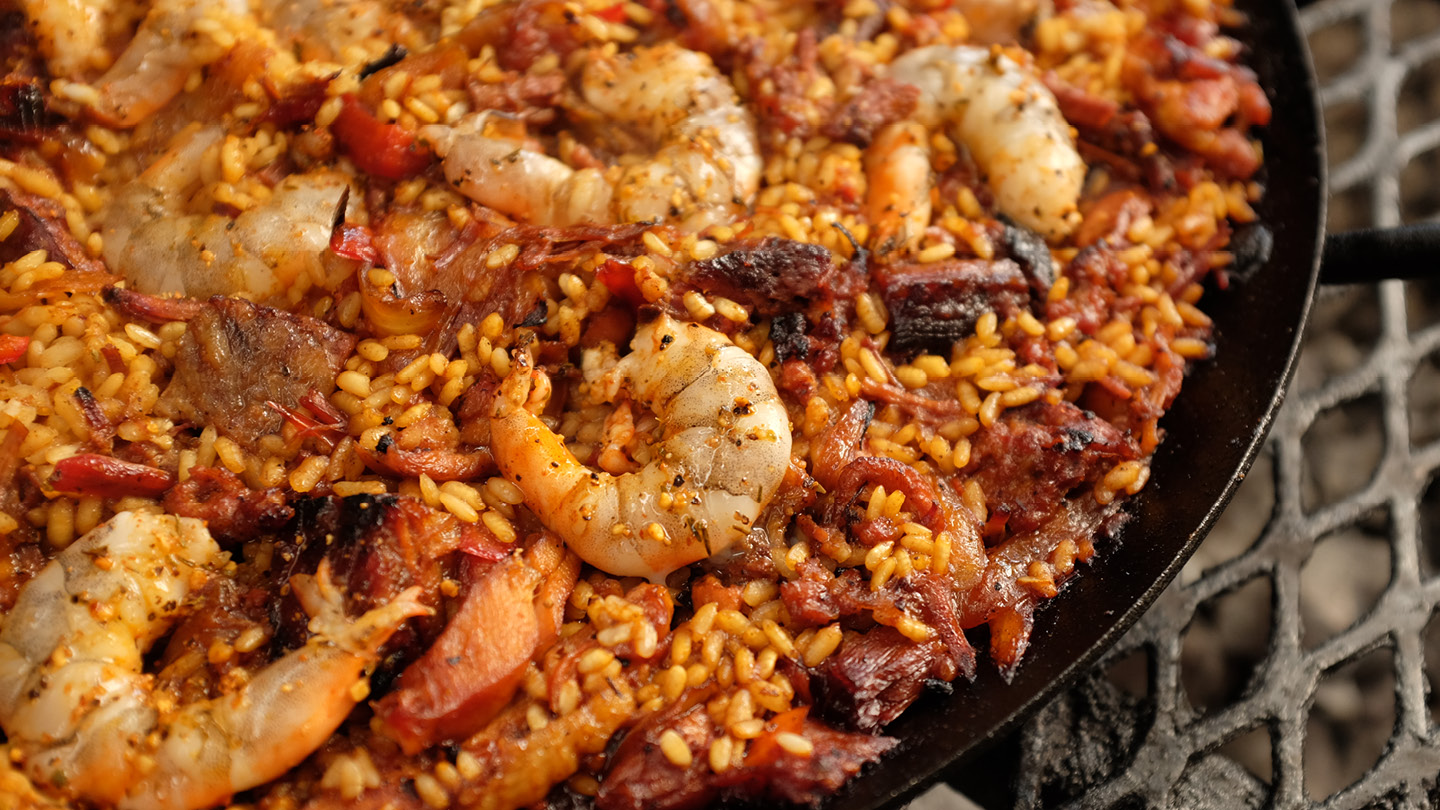
- Season shrimp with Cattleman’s Grill Provisioners Blend Seasoning and nestle them into the rice. Cook until opaque, a few minutes. At the same time, add the corn kernels and break up the smoked salmon over the top to warm.
- Finish out the cook with the lid open until the soccorat is formed on the bottom, about 5-10 minutes. Remove from the grill.
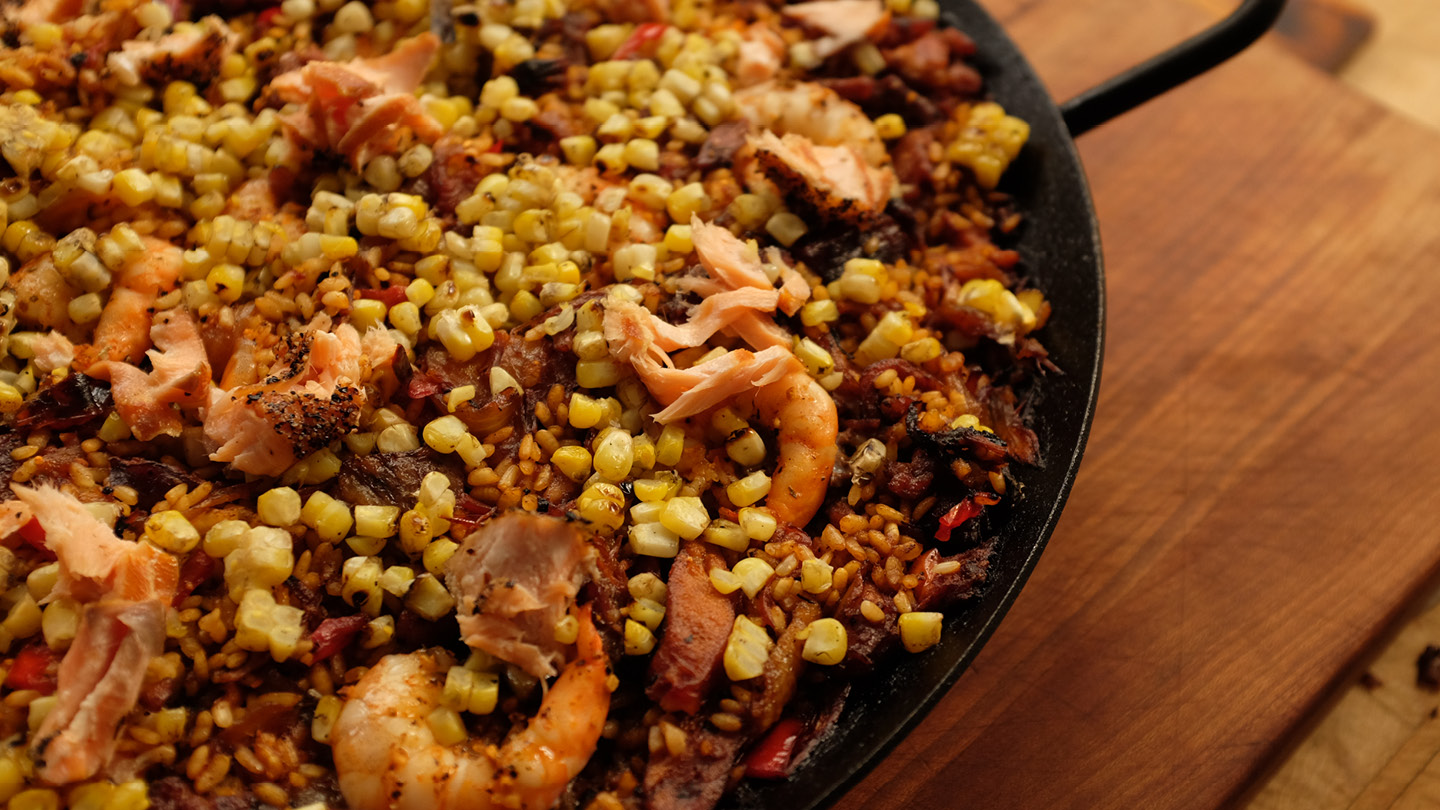
- Drizzle Plowboys BBQ Tarheel Tang Carolina BBQ Sauce and Blues Hog Original BBQ Sauce over the top of the Barbecue Paella. Serve immediately.
Recipe Note
Recipe FAQ
What is paella and where does it come from?
Paella is a Spanish rice dish originating in Valencia, where the word "paella" literally means "frying pan" — the shallow, wide pan the dish is cooked in. Traditional Valencian paella is flavored with saffron and cooked with chicken, rabbit, or seafood alongside short-grain rice. The key technique is developing the socarrat — the caramelized crust that forms on the rice's bottom surface when it's cooked uncovered over direct heat. This Barbecue Paella replaces saffron and traditional proteins with smoked BBQ meats, bringing American low-and-slow flavors into a Spanish technique.
What is Bomba rice and can I substitute Arborio?
Bomba is a short-grain Spanish rice specifically grown in Valencia that absorbs up to three times its volume in liquid while maintaining a firm, al dente center — it's the traditional paella rice. Arborio (the risotto rice) is a reasonable substitute; it absorbs liquid similarly but has a higher starch content that can produce a slightly creamier, softer result than Bomba's more separate, al dente texture. Either works in this recipe; Bomba is preferable if available.
What is the socarrat and how do I know I've achieved it?
The socarrat is the layer of caramelized, slightly crispy rice that forms on the bottom of the paella pan when the liquid is fully absorbed and the pan continues over direct heat. Direction Step 8 specifies cooking with the lid open "until the socarrat is formed, about 5–10 minutes." The visual cue: the edges of the rice where the pan meets the ingredients should show a light golden-brown color. The sound cue: a slight crackling or sizzling from the pan bottom rather than bubbling. Carefully lift a small corner of rice with a spatula — the bottom should be golden and slightly firm, not wet. If it smells like it's burning rather than caramelizing, pull it immediately.
What other dishes are similar to paella?
Several world cuisines have a comparable one-pan rice dish. The closest American equivalent is Cajun jambalaya — same one-pan concept, similar layering of protein and rice, different spice tradition. Risotto uses a similar short-grain rice (Arborio) but is stirred continuously to release starch, producing a creamy texture opposite to paella's separate grains. India's biryani layers spiced rice over marinated meat in a sealed pot. Italy's tiella bakes potatoes, mussels, and rice together. All share the one-pan, rice-as-hero structure; paella's defining distinction is the socarrat.
What leftover BBQ meats work best in this recipe?
Brisket and pulled pork are the strongest choices — both have significant smoke character and rendered fat that integrate into the rice during the cook. Burnt ends work especially well because their caramelized exterior and concentrated flavor distribute through the paella without breaking down into unrecognizable pieces. Smoked chicken, pulled lamb, or chorizo all work as well. Avoid very wet, heavily sauced meats (like ribs in a sticky sauce) — the excess sauce can overwhelm the paella's more delicate flavor balance.
Can I make this indoors?
2 out of 5 — Can be done inside, loses key flavor. A large stovetop skillet over high heat can replicate every step except the charcoal open-fire character. Use the highest BTU burner available; a cast iron skillet preheated thoroughly produces reasonable socarrat. What you lose is the charcoal smoke, the corn's open-fire char, and the live-fire dimension that makes this dish categorically different from a stovetop paella.
Recipe Highlights
Build the stock before anything else — it needs to be simmering and hot before it goes into the rice: Direction Step 2 starts the chicken stock and garlic over direct heat first. Cold stock added to the rice at Direction Step 6 would drop the pan temperature and produce uneven, slow cooking. By the time the sausage, onions, and meats are browned and ready (Steps 4–5), the stock should already be simmering and ready to add immediately.
Smoke the chicken to flavor only — don't cook it through: Direction Step 4 explicitly says "the chicken doesn't need to cook all the way through, just enough to get some smoke." Over-smoking the chicken at this stage means it will be overcooked and dry by the time the paella finishes cooking. Twenty minutes of indirect smoke delivers the flavor; the chicken finishes in the pan during Steps 5–6.
Don't stir the rice after adding the stock — let it cook undisturbed: Traditional paella technique requires not stirring after the rice goes in. Stirring activates the rice's surface starch and produces a sticky, risotto-like result rather than the distinct, separate grains that define paella. Add the stock, distribute the rice evenly once with a spoon, then leave it alone until you check at the 8–10 minute mark.
Nestle the shrimp into the rice — don't place them on top: Direction Step 7 nestles the seasoned shrimp into the rice so they cook partially submerged. Shrimp placed on the surface steam and cook unevenly; partially buried shrimp cook from both the pan heat below and the ambient heat above, producing even cooking in the 3–4 minutes they need to turn opaque.
Recommended Recipes
Nutrition
Nutrition
- Nutrition Serving Size
- 1 cup
- per serving
- Calories
- 499
- Fat
- 15 grams
- Saturated Fat
- 5 grams
- Cholesterol
- 176 milligrams
- Sodium
- 1130 milligrams
- Carbs
- 38 grams
- Fiber
- 2 grams
- Sugar
- 6 grams
- Protein
- 49 grams


