
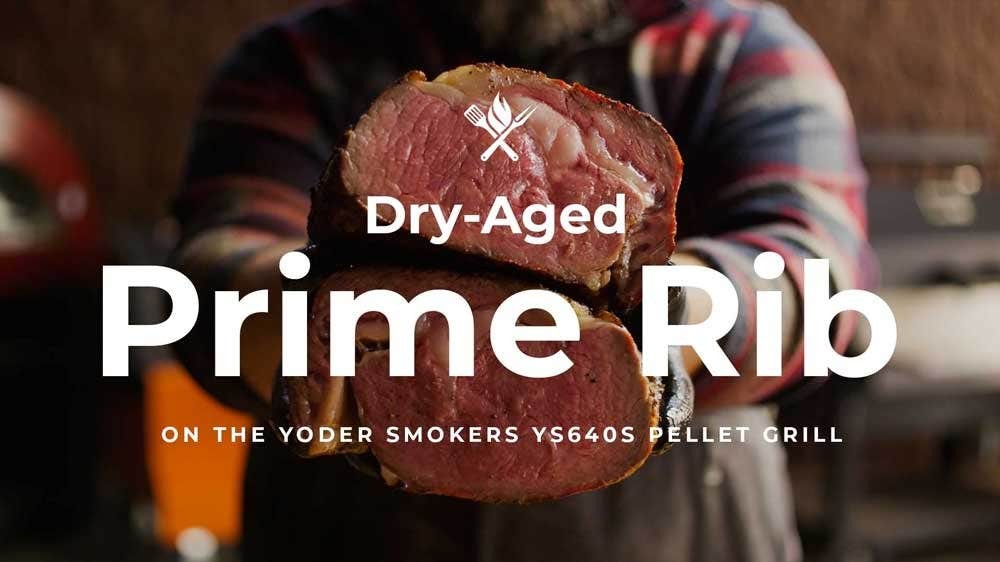
Chef Tom creates the perfect reverse seared Prime Rib recipe on the YS640s Pellet Grill. Aged for 40 days in the Steak Locker, this flavor-packed beef is served with a beef gravy jus made from the dry-aged beef trimmings.
WHAT YOU'LL LOVE
- Turning the trimmed pellicle into the base for the sauce: Browning the hard exterior trimmed off the dry-aged roast before building the stock puts an otherwise-discarded byproduct to work, adding concentrated dry-aged flavor a plain beef stock wouldn't have.
- Smoking low first, then finishing with a hard sear: Bringing the roast up to 100-105°F in the smoker before searing it hard at 500°F builds gentle smoke flavor through the interior first, saving the crust-building step for last.
- Straining the beef stock before turning it into gravy: Removing the solids after simmering leaves a clean, concentrated liquid to build the roux-based gravy from, instead of a chunky stock that would need straining mid-sauce.
- Deglazing with red wine before building the roux: Reducing the wine in the same pan the prime rib seared in lifts the fond into the liquid first, so the butter-and-flour roux that follows builds on that concentrated flavor.
Dry-Aged Prime Rib
Tom Jackson
Rated 4.7 stars by 3 users
Category
Entree
Cuisine
American
Servings
12
Prep Time
15 minutes
Cook Time
3 hours
Calories
1129
Chef Tom fires up the Yoder Smokers YS640s Pellet Grill for a reverse seared Dry-Aged Prime Rib, aged for 40 days in the Steak Locker. The flavor packed beef is served with a beef gravy jus, prepared from the dry-aged beef trimmings.
Ingredients
- 8-9 lb Creekstone Farms Boneless Prime Rib Roast, dry-aged 40 days
-
3-4 tbsp Kozlik’s Dijon Classique
-
Jacobsen Salt Co. Black Garlic Sea Salt
-
Jacobsen Salt Co. Tellicherry Black Peppercorns, fresh cracked
- Trimmed pellicle/rind from dry-aged prime rib, diced
- 1 medium sweet yellow onion, large dice
- 1 medium red onion, large dice
- 1 large carrot, washed, large dice
- 1 bulb fennel, large dice
- 6 cloves garlic, crushed
- 2 tbsp tomato paste
- 2 quarts beef stock
- 6 sprigs fresh thyme
- 1/2 bunch parsley stems, tied with twine
-
2 tbsp Jacobsen Salt Co. Tellicherry Black Peppercorns, whole
- 3 bay leaves
- 1/2 cup dry red wine
- 1 tbsp unsalted butter
- 3 tbsp all purpose flour
- 1 quart dry-aged beef stock (from above)
-
1 tsp Worcestershire sauce
- 1 tsp prepared horseradish
-
Jacobsen Salt Co. Black Garlic Sea Salt, to taste
For the dry aged beef stock:
For the gravy:
Directions
- Preheat the Yoder Smokers YS640s Pellet Grill to 250ºF, set up for smoking, with the second shelf installed.
- Trim the hard pellicle of the dry-aged prime rib away, saving for later use. Slather the prime rib roast with a thin layer of Kozlik’s Dijon Classique mustard. Season the roast generously with Jacobsen Salt Co. Black Garlic Sea Salt and fresh cracked Jacobsen Salt Co. Tellicherry Black Peppercorns.
- Place the dry-aged prime rib roast on the second shelf of the grill and smoke until the internal temperature reaches 100ºF-105ºF, about two to two and a half hours.
- While the prime rib is smoking, prepare the dry-aged beef stock. Dice the reserved pellicle (hard exterior trimmed from the roast) into roughly 1” pieces.
- Preheat a Lodge 6 Quart Enameled Dutch Oven over medium heat. Add the diced pellicle to the dutch oven. Cook to brown, about 5 minutes. Add the onions, carrot, fennel, garlic and tomato paste. Cook for a few minutes, stirring. Add the beef stock, fresh herbs, peppercorns and bay leaves. Bring to a simmer. Turn the heat down to low. Cover with a lid and let simmer while the roast is smoking.
- When the prime rib roast surpasses 105ºF, remove the roast from the grill and cover with foil. Remove the door from the two-piece diffuser (or the entire diffuser). Place a Lodge Cast Iron Casserole Dish over the fire box and crank the heat up to 500ºF.
- Strain the dry aged beef stock through a fine mesh strainer. Discard the solids. Reserve the liquid.
When the grill comes up to temperature (about 10 minutes), sear the prime rib roast in the cast iron casserole pan. Roll to sear on all sides. Remove from the grill when the internal temperature reaches 120ºFº. Cover with foil and let rest while you prepare the beef gravy jus.
- Turn the grill temperature down to 400ºF.
- Deglaze the casserole dish with the red wine, scraping up the bits stuck to the bottom. Cook until the red wine is nearly entirely reduced out. Add the butter and flour to the dish and stir to form a roux. Cook for about 1-2 minutes.
- Add up to one quart of dry-aged beef stock to the roux (start with about half), whisking constantly to remove any lumps. Add the Worcestershire sauce and prepared horseradish. Adjust consistency as needed by adding more stock. Adjust seasoning with salt, as needed.
- After resting the prime rib roast for about half an hour, slice to serve. Serve the Dry-Aged Beef Gravy Jus alongside the Dry-Aged Prime Rib.
Recipe Note
Recipe FAQ
Why save and brown the trimmed pellicle instead of discarding it?
The hard exterior trimmed off the dry-aged roast carries concentrated dry-aged flavor. Browning it and building it into the stock puts that flavor to use, instead of throwing away what would otherwise be scrap.
Why smoke the roast low first, then finish with a hard sear at the end?
Bringing the roast up to 100-105°F in the smoker first builds gentle smoke flavor through the interior. Searing hard afterward at 500°F builds the crust last, so you get both smoke and char instead of one at the expense of the other.
Why strain the beef stock before turning it into gravy?
Removing the solids leaves a clean, concentrated liquid that's easy to whisk into the roux without needing to strain again partway through building the sauce.
Why deglaze with red wine before adding the butter and flour?
Reducing the wine in the same pan the roast seared in lifts the browned fond into the liquid first. Building the roux afterward means it develops on top of that concentrated flavor instead of a clean, empty pan.
What internal temperature should the prime rib actually reach?
This recipe pulls it at 120°F after the sear, a rare-to-medium-rare finish. As a whole-muscle cut of beef, this is safe and standard practice — there's no minimum cook temperature requirement the way there is for ground meat.
How indoor-friendly is this recipe?
3 out of 5 — a regular oven can handle the low-temperature smoke stage (minus the smoke flavor), and a hot cast iron skillet or broiler can finish the sear; the gravy comes together entirely on the stovetop.
Recipe Highlights
Pellicle-built stock: Puts trimmed scraps to work as concentrated flavor.
Smoke-then-sear method: Builds interior smoke flavor before the final crust.
Strained stock base: Keeps the gravy build clean and lump-free.
Wine-deglazed roux: Builds the gravy on top of concentrated pan flavor.
Recommended Recipes
Nutrition
Nutrition
- Nutrition Serving Size
- 7.11 oz
- per serving
- Calories
- 1129
- Carbs
- 12 grams
- Protein
- 78 grams
- Fat
- 82 grams
- Sodium
- 3509 milligrams


