

Follow Chef Tom as he takes you through an in-depth comparison of these two cuts of beef, from brining and seasoning, to smoking and boiling. You won't want to miss out on this unique and delicious culinary experiment.
WHAT YOU'LL LOVE
- One brine, two completely different endings. The brisket flats sit in the exact same salt-and-spice brine for 7-10 days — what happens after (smoke vs. simmer) is what actually splits pastrami from corned beef.
- Toasting the pickling spice isn't optional flavor theater. A quick dry-toast of the coriander and peppercorns in a hot skillet before it goes into the brine wakes up the oils so the spice actually punches through the meat instead of just floating in the liquid.
- The overnight low-and-slow start sets up the bark. Letting the pastrami ride at 190°F while you sleep, then bumping to 250°F in the morning, is what gives it that dark, peppery crust before the wrap phase even starts.
- Foil-wrap-and-rest applies to both cuts. Whether it came off the smoker or out of the stockpot, resting wrapped in a cooler for at least an hour before slicing is what keeps both the pastrami and the corned beef from drying out on the cutting board.
Pastrami vs. Corned Beef
Tom Jackson
Rated 4.6 stars by 12 users
Category
Main Course
Cuisine
American
Servings
14
Prep Time
2 hours
Cook Time
1 hour
Calories
165
Chef Tom walks us through a side-by-side comparison of Pastrami vs. Corned Beef! From brining to seasoning to smoking vs. boiling, we'll cover every step of the cooking processes to fully compare and contrast these two cuts of beef!
Ingredients
- 2 beef brisket flats
- 1 gallon water
- 1 1/2 cup kosher salt
- 1 cup sugar
- 4 1/2 tsp pink salt (sodium nitrite)
- 10 cloves garlic, crushed
- 1/4 cup pickling spice (recipe below)
- 8 1/2 lb ice
-
Depending on the size of your brisket, and the container in which you are brining, you may need to multiply this recipe. You will need enough brine to cover the brisket in the brining container.
- 1 tbsp coriander seeds
-
1 tbsp black peppercorns
- 1 tbsp mustard seeds
- 1 tbsp red chile flakes
- 1 tbsp allspice berries
- 1 tbsp whole cloves
- 1 tsp ground ginger
- 1 tsp ground mace
- 1 small cinnamon stick, crushed
- 2 bay leaves, broken into pieces
-
Kozlik’s Market Mustard
-
1/4 cup black peppercorns, toasted, coarsely ground
- 1/4 cup coriander seeds, toasted, coarsely ground
- 4 cups yellow onion, large dice
- 2 cups carrots, large dice
- 2 cups celery, large dice
- 1/4 cup pickling spice
Brine
Note
Pickling Spice
Pastrami
Corned Beef
Directions
- For the pickling spice, in a dry hot 12” Lodge Steel Skillet, toast the coriander and black peppercorns just until fragrant. Be careful not to burn them. Combine the toasted spices with the remaining spices. Store in a sealed container.
- Combine all brine ingredients, except the ice, in a large pot. Bring to a boil and stir until salt and sugar are dissolved.
- Add the ice to a large Briner Bucket. Pour the brine mixture over the ice. Stir to melt the ice.
- Place briskets in the brining liquid. Lock the plate in place to make sure it is fully submerged. Refrigerate for 7-10 days.
- Remove briskets from brine, and rinse thoroughly under cold water. Pat dry with paper towels.
For the Pastrami
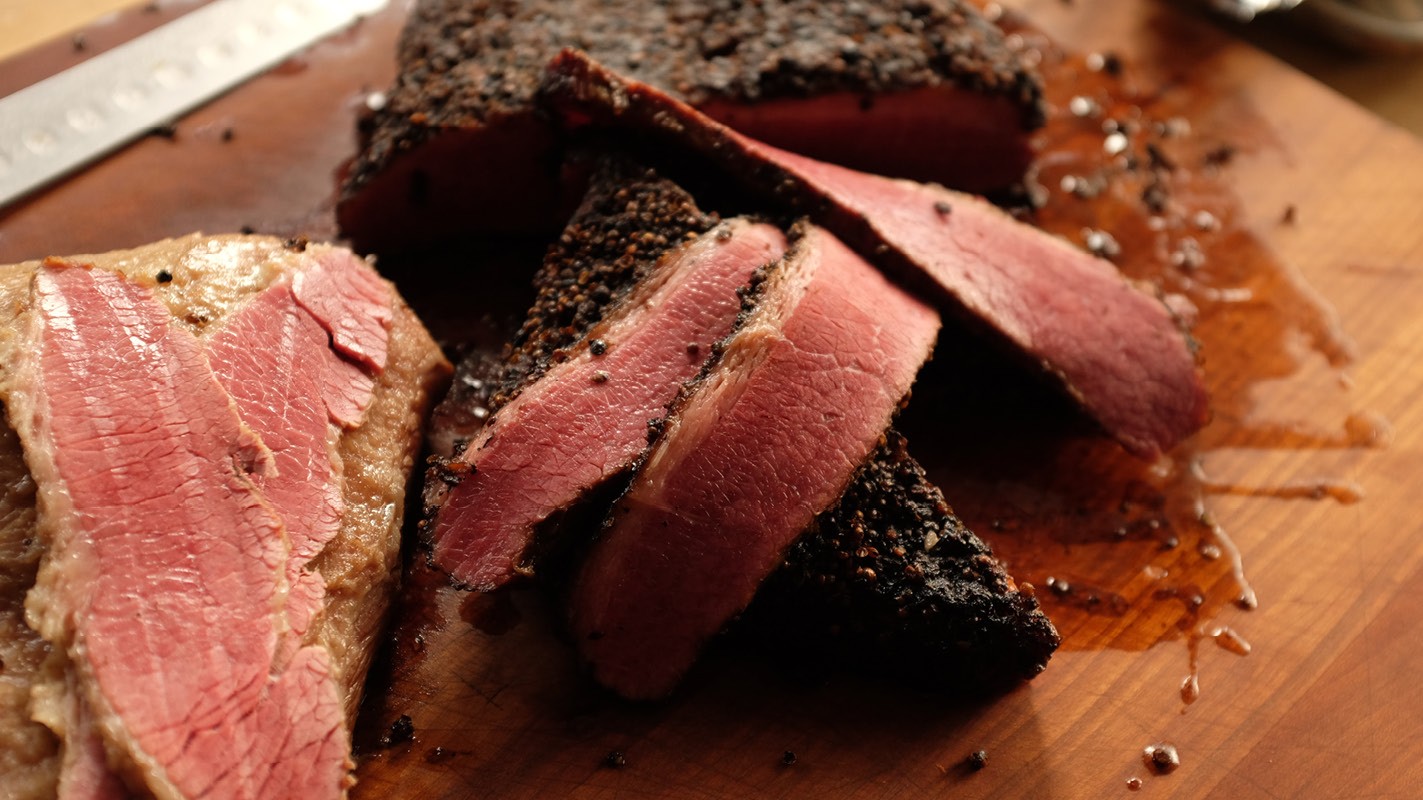
- Apply a thin layer of Kozlik’s Market Mustard to the surface of the meat to help the rub adhere. Coat the brisket with the coriander/black pepper rub.
- Preheat your Yoder Smokers YS480s Pellet Grill to 190ºF. Place the pastrami brisket in the smoker before going to bed. Let smoke overnight.
- In the morning (8-10 hours later), increase the grill temperature to 250ºF and continue smoking until a dark bark is formed and the internal temperature is 155ºF-170ºF.
- Wrap the pastrami in foil and continue cooking until the meat is probe tender and the internal temperature is around 200ºF-210ºF. Remove from the grill. Place in a room temp cooler and rest for at least an hour before slicing.
For the Corned Beef
- Place the brined brisket in a large stock pot. Add the onion, celery and carrots in the pot, as well as 1/4 cup pickling spice. Cover with cool water by 4”-6”. Place on the burner of the Bayou Classic Turkey Fryer. Cover and bring to a simmer over high heat. Turn the heat down to just maintain a simmer. Cook until the internal temperature reaches 205ºF, about 2-2.5 hours.
- Remove from the stockpot. Wrap in foil. Rest in a cooler for at least one hour before slicing.
Recipe Note
Recipe FAQ
Why brine both briskets in the exact same liquid?
Pastrami and corned beef start from the same base — a salt, sugar, and pickling-spice brine cured with pink salt. The entire difference between the two comes down to what happens after the brine: one gets smoked, the other gets simmered.
Why toast the pickling spice before adding it to the brine?
Briefly toasting the coriander seeds and peppercorns in a dry hot skillet releases their essential oils, giving the brine (and eventually the meat) a more pronounced spice flavor than adding them raw.
Why does the brisket need 7-10 days in the brine?
Curing a full brisket flat takes time for the salt and pink salt to penetrate all the way to the center of the meat. Cutting the brine time short risks an unevenly cured interior.
Why smoke the pastrami overnight at a lower temperature first?
Starting at 190°F and holding there for 8-10 hours lets the bark develop slowly without the meat overcooking before you're ready to bump the heat and finish it the next morning.
Why rest both the pastrami and corned beef in a cooler before slicing?
Resting wrapped in foil for at least an hour lets the juices redistribute through the meat instead of running out onto the cutting board, which keeps every slice moist.
What's the difference in doneness targets between the two?
Pastrami is pulled once it's probe-tender around 200-210°F internal, while corned beef is simmered to about 205°F. Both are well past the safe minimum for beef, so these targets are about texture, not food safety.
How indoor-friendly is this recipe?
3 out of 5 — the corned beef half is entirely doable on a stovetop with a stockpot, but the pastrami half depends on an actual smoker for the overnight low-temp hold and bark development, which can't be replicated in an oven.
Recipe Highlights
Step 4 (Brine): The 7-10 day refrigerated brine under a Briner Bucket lock plate is what fully cures both brisket flats before they ever split into two different cooking methods.
Step 2 (Pastrami): Smoking overnight at a gentle 190°F before increasing heat in the morning prevents the bark from forming too fast and drying out the exterior before the interior catches up.
Step 3 (Pastrami): Bumping to 250°F only after the overnight hold is what finishes building a dark, well-set bark once the meat has already absorbed several hours of smoke at a lower temp.
Step 1 (Corned Beef): Simmering the brined brisket with onion, celery, carrot, and pickling spice infuses aromatics directly into the cooking liquid the meat sits in for over two hours, which the dry-smoked pastrami never gets.
Recommended Recipes
Nutrition
Nutrition
- Nutrition Serving Size
- 4 oz
- per serving
- Calories
- 165
- Fat
- 6 grams
- Saturated Fat
- 3 grams
- Cholesterol
- 76 milligrams
- Sodium
- 991 milligrams
- Carbs
- grams
- Fiber
- grams
- Sugar
- grams
- Protein
- 24 grams


