

If you’re a hunter or have one in the family, chances are good you’ve got some venison in the freezer. One of our favorite ways to use ground venison is turning it into flavorful, smoky Venison Summer Sausage right in your outdoor kitchen. With the right seasoning blend and a few key tips, you can make high-quality, better-than-store-bought wild game sausage at home—no fancy meat plant required.
This recipe uses a simple technique for smoking summer sausage on a pellet grill, producing that signature tangy bite and snappy texture summer sausage is known for. Whether you’re prepping for a road trip, a holiday gift basket, or your next charcuterie board, this venison sausage is perfect sliced thin with crackers, cheese, and pickles—or just straight from the fridge.
What You'll Love
- Hunter's freezer, transformed. This recipe is built specifically for ground venison — the lean, deep-flavored wild game most hunters have in surplus after season. The 2:1 venison-to-fat ratio and the LEM Backwoods seasoning blend solve the two problems venison sausage most often faces: dryness and flat flavor.
- High-temp cheese changes everything. LEM High Temp Cheddar and High Temp Hot Pepper cheeses are formulated to hold their shape at smoking temperatures — they won't melt into the sausage during the cook but instead create distinct pockets of cheesy, spicy richness in every slice. Standard cheese would disappear into the grind.
- The pellet grill as a smokehouse. Starting at 200°F and slowly climbing to an internal temperature of 160°F mimics the traditional smokehouse process — the gradual heat rise keeps the fat emulsified and the texture uniform. The YS640s holds temperature with the precision this cook requires.
- Gift-worthy, road-trip-ready. Sliced thin on a charcuterie board, packed in a cooler for deer camp, or wrapped up as a gift for hunting season — homemade venison summer sausage belongs in more places than just the plate.
Venison Summer Sausage
Tom Jackson
Rated 3.5 stars by 13 users
Category
Appetizer
Cuisine
American
Servings
48
Prep Time
30 minutes
Cook Time
1 hour
Calories
269
Why Venison Makes Great Summer Sausage
Venison’s lean nature and deep, beefy flavor make it an ideal protein for homemade summer sausage. Since wild game meat is typically very low in fat, we recommend blending it with beef or pork fat to give your sausage the right balance of moisture and richness. In this recipe, we use beef fat off of a strip loin—a flavorful, fatty cut that helps prevent dry or crumbly sausage.
You’ll also notice this isn’t just any old seasoning blend. We’re using the LEM Backwoods Summer Sausage Blend as well as LEM High Temperature Cheddar and LEM High Temperature Hot Pepper cheeses which gives the sausage that tangy and cheesy flavor you expect from summer sausage. It’s a shortcut the pros use, and it works beautifully here.
The Key to Smoking Summer Sausage
One of the most important elements of summer sausage is the low-and-slow smoke. The goal is to slowly raise the internal temperature while letting smoke flavor soak into the meat. That slow climb helps the fat stay emulsified and keeps the sausage tender with a uniform texture.
We smoke this sausage on a Yoder Smokers YS640s pellet grill at a relatively low temp, gradually increasing until the internal temperature reaches 155°F. This method mimics the slow cooking process you’d get in a traditional smokehouse, but it’s achievable in your backyard with the right tools.
This Venison Summer Sausage recipe is a great entry point into the world of homemade cured meats and smoked wild game. Once you make a batch yourself, you’ll see why so many hunters skip the processor and go DIY. With a reliable seasoning blend, the right ratio of venison and pork, and a steady cook on the smoker, you’ll end up with sausages that are perfect for gifting, snacking, or stashing in your cooler for the next road trip.
Getting Started
Ready to get started? Watch the video, gather your gear, and dive into one of the most satisfying ways to preserve and enjoy wild game.
Ingredients
Directions
- Grind the fat and venison together using a fairly small die (4.5 mm). Transfer the mixture to the bowl of a stand mixer.
Mix together the contents of the packet of LEM Backwoods Summer Sausage Seasoning & Cure with the recommended amount of water. Whisk to dissolve as much as possible. Pour the mixture over the ground meat and fat.
Using the paddle attachment, beat the mixture on medium for 30-60 seconds until the mixture is tacky and holds together. Quickly mix in the LEM High Temperature Cheddar and LEM High Temperature Hot Pepper cheeses until well distributed. Transfer to the refrigerator to chill.
Place two LEM 2 1/2" X 20" Fibrous Casings in warm water, and soak for at least 30 minutes.
- Transfer the sausage mixture to your sausage stuffer, fitted with a wide stuffing tube. Remove the casings from the water, thread onto the stuffing tube. Fill the casing with the sausage, twist the end of the casing and tie off with butcher's twine. Repeat with the second casing.
- Place the sausages in the refrigerator on a wire rack (cooling rack). Let sit overnight.
The next day, preheat your Yoder Smokers YS640 pellet grill to 200°F. Place the summer sausages on the second shelf of the cooker and smoke until the internal temperature reaches 160°F. Remove from the grill and place in the refrigerator to chill. Remove casing and slice to serve.
Recipe Note
Recipe FAQ
Why do I need to add beef or pork fat to venison, and what ratio works best?
Venison is an exceptionally lean meat — most cuts have almost no intramuscular fat, and ground venison by itself produces a sausage that is dry, crumbly, and lacks the rich mouthfeel that makes summer sausage satisfying. Fat is the delivery vehicle for flavor and moisture in any sausage: it carries aromatic compounds from the seasoning, keeps the texture smooth and cohesive during the cook, and prevents the finished sausage from being chalky. This recipe uses a 2:1 venison-to-fat ratio (4 lbs venison, 2 lbs beef fat) — that roughly 33% fat content produces a moist, sliceable sausage without feeling greasy. Going below 20% fat risks a dry result; going above 40% produces a soft, almost spreadable texture more typical of a pâté.
Why does the meat need to be partially frozen before grinding?
Partially frozen meat grinds more cleanly than fully thawed or room-temperature meat. When meat is cold — but not fully frozen — the fat stays firm rather than smearing against the grinder die, which produces clean, distinct fat particles distributed throughout the grind rather than a fatty paste that can make the sausage greasy-textured and poorly emulsified. The clean grind also produces a better bind during the paddle mixing step: discrete fat particles suspend in the protein matrix more effectively than smeared fat does. Chill your grinder parts in the freezer for 30 minutes before grinding for the same reason.
Why beat the sausage mixture with a paddle attachment rather than just mixing by hand?
The 30–60 second paddle mixing on medium speed develops myosin — a protein in meat that, when worked, creates a sticky, binding matrix that holds the sausage together during stuffing and cooking. Myosin extraction is what gives sausage its characteristic firm, sliceable texture; insufficient mixing produces a crumbly sausage that falls apart when sliced. Hand mixing can develop some myosin, but not as efficiently or consistently as the mechanical action of a stand mixer paddle at medium speed. The test for sufficient mixing is "primary bind" — the mixture should be visibly tacky and hold its shape when pressed.
Why does the sausage need to rest overnight in the refrigerator before smoking?
The overnight rest allows the cure from the LEM Backwoods packet — sodium nitrite — to distribute evenly throughout the sausage and begin working at the cellular level. Cure requires time and cold temperature to migrate through a dense sausage log; smoking immediately after stuffing would mean the outside reaches temperature before the cure has fully penetrated, producing uneven curing and potentially compromising food safety. The overnight rest also allows the casing to dry slightly, which helps smoke adhere more effectively during the cook — wet casings repel smoke, producing patchy smoke penetration.
Can I cook this Indoors?
We rate this a 2 out of 5 for cooking indoors. Can be done inside, but loses key flavor or texture. The mixing, stuffing, and overnight cure are entirely kitchen-native. A home oven set to 200°F can bring the sausage to 160°F internal temperature over a similar time window. What you lose is the pellet smoke — summer sausage without smoke is seasoned, cured meat in a casing, but it's missing the characteristic smokiness that defines the format. Without smoke, the LEM Backwoods seasoning and high-temp cheeses are excellent, but the result reads as a different product. An A-MAZE-N tube smoker in a cold grill can add cold smoke before the oven finish as a workaround.
Recipe Highlights & Insights
The LEM Backwoods Summer Sausage Seasoning & Cure packet is the ingredient that makes this recipe accessible to first-time sausage makers. The packet combines the seasoning blend and the curing salt in calibrated proportions for the recipe's 6 lb meat batch — no measuring sodium nitrite by weight, no separate cure calculations. For a cured meat product where cure quantity matters for both flavor and food safety, the all-in-one packet eliminates the most technically demanding part of sausage making. The instructions on the packet specify the water quantity to dissolve the cure; follow them precisely, as the cure-to-water ratio affects how thoroughly the cure distributes through the meat during mixing.
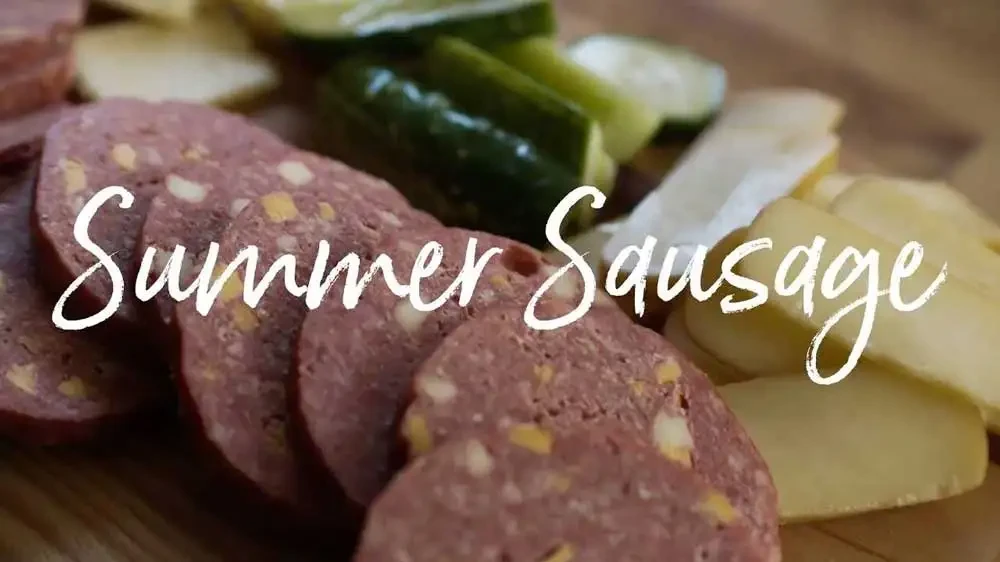
LEM High Temperature cheeses are a product category worth understanding. Standard cheddar or pepper jack melts at roughly 130°F and will completely liquefy into the sausage during a 160°F cook, leaving greasy pockets and no visible cheese. High-temperature cheeses are manufactured with a process that raises their melt point to around 200°F — they hold their shape and identity throughout the entire smoke, producing the clean white and yellow pockets visible in a properly made summer sausage cross-section. The visual and textural distinction between high-temp cheese and standard cheese in smoked sausage is dramatic. Both the cheddar and hot pepper varieties are available in the ATBBQ catalog.
The fibrous casing used here — LEM 2.5" x 20" — is a non-edible, mahogany-colored fibrous casing specifically sized for summer sausage. It's not eaten; it's peeled before serving. Soaking in warm water for 30 minutes before stuffing is required: the casing needs to hydrate to become flexible enough to stuff without tearing. A dry fibrous casing will crack or split under stuffing pressure. These casings are permeable to smoke — unlike collagen casings or natural casings used for fresh sausages, fibrous casings allow smoke to penetrate the sausage surface during the cook, which is essential for a smoked product.
At 269 calories per 2.21 oz serving across 48 servings from a 6 lb batch, this recipe produces approximately 6.6 lbs of finished sausage (some weight is lost to moisture during the smoke). The 24g fat per serving reflects the 33% beef fat content, and the 11g protein reflects the lean venison base. The nutrition panel is significantly incomplete — % DV fields are missing from all four listed nutrients, and Saturated Fat, Fiber, Sugar, and Cholesterol are entirely absent. The 3.5-star rating from 13 users is the lowest in the wild game catalog and may reflect the technical difficulty of the recipe for first-time sausage makers rather than a recipe quality issue.
Recommended Recipes
Nutrition
Nutrition
- Nutrition Serving Size
- 2.21 oz
- per serving
- Calories
- 269
- Carbs
- 1 grams
- Protein
- 11 grams
- Fat
- 24 grams
- Sodium
- 213 milligrams


