
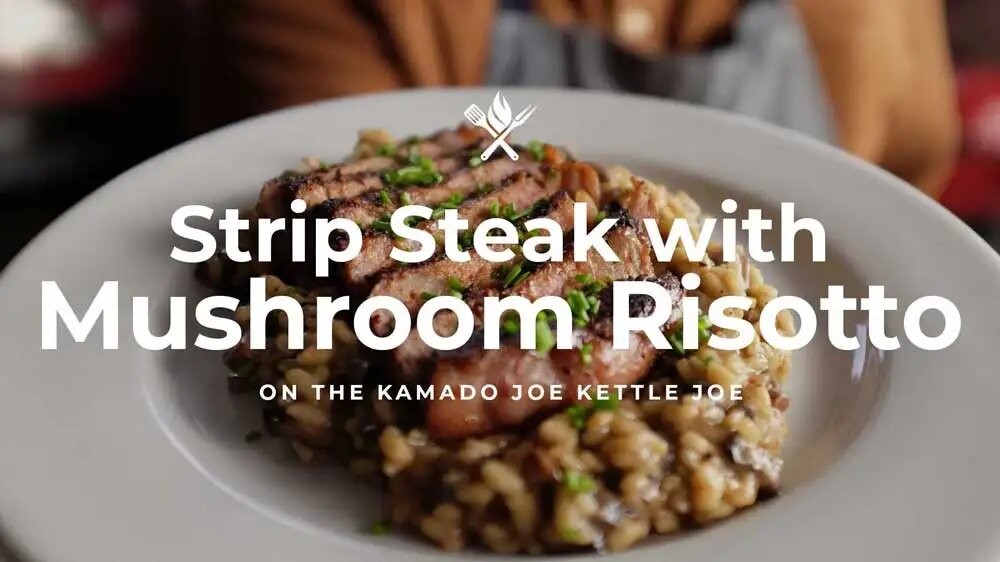
Chef Tom cooks up the most delicious rice dish over a charcoal fire on the Kamado Joe Kettle Joe, with a truly impressive steak. This is Strip Steak with Mushroom Risotto.
WHAT YOU'LL LOVE
- Building the risotto in the same skillet the steak seared in: Cooking the shallots and mushrooms directly in the fond left behind from searing the steak ties the whole dish back to the same beefy flavor, instead of starting the risotto in a clean pan.
- Toasting the rice before adding any liquid: Stirring the arborio in oil for a minute before the wine or stock goes in coats each grain and helps it hold its shape as it cooks, rather than turning mushy.
- Reducing the wine until the pan is nearly dry before adding stock: Cooking off almost all the wine concentrates its flavor into the rice first, so the chicken stock added afterward builds on that base instead of diluting it.
- Adding the stock gradually, a half-cup at a time: Ladling in liquid slowly and letting each addition fully absorb before adding more is what gives risotto its signature creamy texture, rather than dumping in all the stock at once and ending up with soupy or unevenly cooked rice.
Strip Steak with Mushroom Risotto
Tom Jackson
Rated 5.0 stars by 1 users
Category
Entree
Cuisine
American
Servings
2
Prep Time
15 minutes
Cook Time
30 minutes
Calories
1281
Chef Tom creates an amazing recipe on the Kamado Joe Kettle Joe. Enjoy perfectly cooked Strip Steak and Mushroom Risotto over a charcoal-fired flame for an unforgettable taste.
Ingredients
- 1 Creekstone Farms Prime Strip Steak
-
Cattleman’s Grill California Tri-Tip Steak Seasoning, fine ground
- 2 tbsp unsalted butter
-
extra virgin olive oil
- 1/4 cup shallot, minced
- 3 cups (about 6 oz) portobello mushrooms, diced
- 2/3 cup arborio rice
- 1/4 cup white wine
- 1 clove garlic, minced
- 3-4 cups chicken stock
- 1/3 cup pecorino romano cheese, finely grated
Directions
- Fill the firebox of your Kamado Joe Kettle Joe with lump charcoal. Light the charcoal and build a hot coal bed, stabilizing the temperature of the grill around 500ºF with the grill set up for direct grilling. Bank the majority of the coals toward the back of the grill for two zone cooking.
- Preheat a Lodge 10” Cast Iron Skillet on the grill.
- Place a quart of chicken stock in a small sauce pot and bring to a simmer. Keep warm, covered, on the grill.
- Season your steak with Cattleman’s Grill California Tri-Tip Steak Seasoning, ground in a spice grinder.
- Sear the steak on both sides inside the skillet. Cook until the internal temperature reaches 120ºF. Remove from the grill .Wrap in foil and set aside.
Melt one tablespoon of butter and one tablespoon of extra virgin olive oil in the skillet with the fond from the steak. Add the shallots to the skillet and cook briefly (one minute). Add the diced portobello mushrooms. Cook until browned and softened. Remove the shallots and mushrooms from the skillet.
Drizzle another tablespoon of extra virgin olive oil in the skillet. Add the rice and toast for a minute, stirring frequently.
- Add the wine to the skillet and cook until it is almost entirely reduced out (skillet nearly dry). Stir in the garlic and let cook for about 30 seconds.
- Ladle in the hot chicken stock, about 1/2 cup at a time, stirring constantly until the liquid has been absorbed. Continue adding 1/2 cup of liquid at a time until the rice is softened and a creamy sauce is formed.
- Stir in the cheese and last tablespoon of butter.
- Slice the steak and serve over risotto.
Recipe Note
Recipe FAQ
Why build the risotto in the same skillet the steak seared in?
Cooking the shallots and mushrooms directly in the fond left behind from searing the steak ties the whole dish back to the same beefy flavor, instead of starting the risotto in a clean, empty pan.
Why toast the rice in oil before adding any liquid?
Stirring the arborio rice in oil for a minute coats each grain and helps it hold its shape through the cook, rather than turning mushy once the liquid starts going in.
Why reduce the wine until the pan is nearly dry before adding the stock?
Cooking off almost all the wine concentrates its flavor into the rice first. Adding stock too soon would dilute the wine before it's had a chance to reduce and intensify.
Why add the stock gradually instead of all at once?
Ladling in liquid a half-cup at a time and letting each addition fully absorb before adding more is what gives risotto its signature creamy texture. Dumping in all the stock at once would leave you with soupy, unevenly cooked rice instead.
What internal temperature should the strip steak actually reach?
This recipe pulls it at 120°F, a rare finish. As a whole-muscle cut of beef, this is safe and standard practice — there's no minimum cook temperature requirement the way there is for ground meat.
How indoor-friendly is this recipe?
4 out of 5 — a hot cast iron skillet on the stovetop can sear the steak and build the risotto exactly the same way; the grill mainly adds a touch of char to the steak.
Recipe Highlights
Fond-built risotto: Ties the dish back to the same flavor as the seared steak.
Toasted rice: Helps grains hold their shape instead of turning mushy.
Wine reduction: Concentrates flavor into the rice before stock is added.
Gradual stock addition: Builds the creamy texture that defines risotto.
Recommended Recipes
Nutrition
Nutrition
- Nutrition Serving Size
- 25.27 oz
- per serving
- Calories
- 1281
- Carbs
- 70 grams
- Protein
- 130 grams
- Fat
- 52 grams
- Sodium
- 2127 milligrams


