

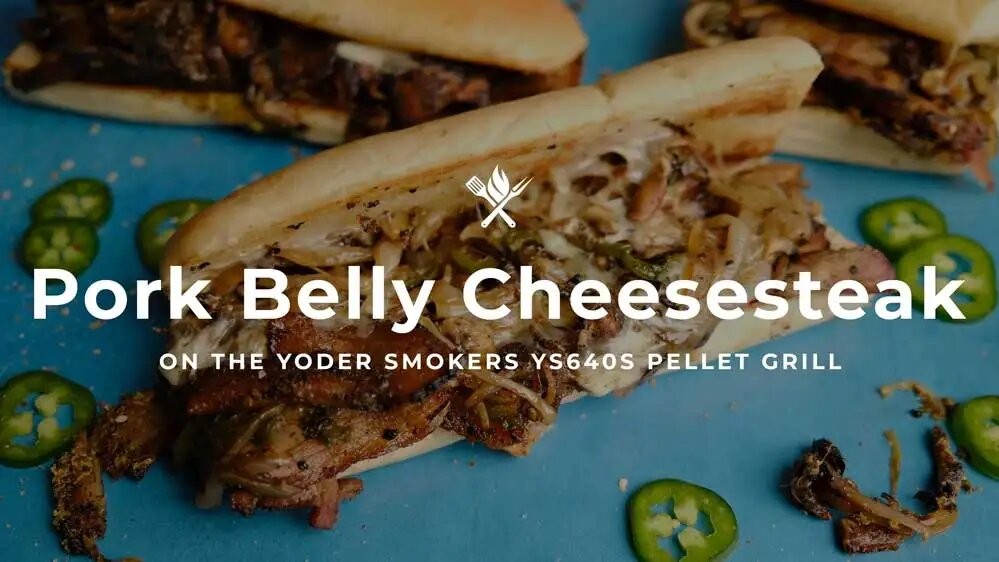
Chef Tom fires up the Yoder Smokers YS640s Pellet Grill for a tasty spin on the Philly Cheesesteak with his Pork Belly Cheesesteak.
WHAT YOU'LL LOVE
- Roasting the pork belly ahead, then chilling it before slicing: Cooking the belly to 190°F and chilling it fully before slicing firms up the fat, letting you cut clean, thin slices that would tear or fall apart if sliced while warm.
- Cooking the pork on the griddle to crisp the edges: Griddling the pre-cooked, thin-sliced pork belly crisps its edges the way a classic cheesesteak's shaved beef would sear, giving it texture the initial roast alone doesn't provide.
- Building the toppings in the pork's own rendered fat: Cooking the onions, jalapeños, and mushrooms in the fat left behind from the pork ties the whole topping mixture back to the same flavor as the meat.
- Steaming the cheese with a splash of water on the griddle: Adding water and covering the portions with a pan melts both cheeses quickly and evenly without needing to transfer the sandwich to another heat source.
Pork Belly Cheesesteak
Tom Jackson
Rated 4.8 stars by 14 users
Category
Entree
Cuisine
American
Servings
8
Prep Time
20 minutes
Cook Time
2 hours 1 minute
Calories
816
Chef Tom takes grilling to a whole new level with his Pork Belly Cheesesteak made on the Yoder Smokers YS640s Pellet Grill. Enjoy a delicious spin on a classic with this amazing flavor combo.
Ingredients
- 2 lb Creekstone Farms Duroc Pork belly
-
2 tbsp Worcestershire sauce
-
Cattleman’s Grill California Tri-Tip Seasoning
- 1 medium/large yellow onion, sliced thin
- 8 oz button mushrooms, sliced thin
- 3 large jalapeños, sliced thin
- 4 slices provolone cheese
- 4 slices white American cheese
- 4 (8”) sub sandwich rolls
-
Pork Lard, as needed
-
Kozlik's Dijon Classique
Directions
- Preheat your Yoder Smokers YS640s Pellet Grill to 325ºF, set up for indirect grilling.
- Slather the pork belly in the Worcestershire sauce. Season all surfaces with Cattleman’s Grill California Tri-Tip Seasoning.
- Roast the pork belly on the second shelf of the grill until the internal temperature of the belly reaches about 190ºF, about 2 hours cook time.
- Cool the belly to room temperature then wrap in foil and place in the refrigerator until fully chilled (a couple of hours or overnight).
- Set up the grill for cooking on the griddle. Remove the second shelf, remove the diffuser door (or entire diffuser). Place the Yoder Smokers Reversible Cast Iron Griddle directly over the fire box, and set the temperature at 425ºF.
- Slice the chilled pork belly into very thin slices.
- Melt a couple of tablespoons of the mangalista lard on the hot griddle. Place the sub rolls cut side down to toast. Remove from the griddle when golden brown.
- Add the thin sliced pork to the griddle. Cook until crispy around the edges, then remove from griddle and place on paper towels to soak up excess fat.
- Add onions, and jalapeños and cook in the fat left behind on the griddle. Toss and cook until softened and browned. Add mushrooms. Cook until softened. Mix all. Move to the front of the griddle.
- Portion pork out on the griddle. Top with veggies. Top each portion with a slice of American and a slice of provolone. Add some water to the griddle. Cover with a pan. Steam until the cheese is melted. Scoop off the griddle and land on the toasted rolls, spread with Kozlik's Dijon Classique.
- Slice sandwiches in half and serve.
Recipe Note
Recipe FAQ
Why roast the pork belly and chill it before slicing, instead of slicing it right after cooking?
Chilling the belly fully firms up the rendered fat, letting you cut clean, thin slices for the griddle. Slicing it warm would cause it to tear or fall apart instead of holding together in neat pieces.
Why cook the pre-roasted pork belly again on the griddle?
Griddling the thin-sliced pork crisps its edges the way shaved beef sears on a classic cheesesteak griddle, adding a textural contrast that the initial low-and-slow roast alone doesn't create.
Why cook the onions, jalapeños, and mushrooms in the pork's rendered fat instead of fresh oil?
Using the fat left behind from the pork ties the vegetable topping's flavor back to the meat itself, instead of introducing a separate, neutral cooking fat.
Why add water and cover the cheese with a pan instead of just letting it melt uncovered?
Steaming the cheese with a splash of water and a covering pan melts both the provolone and American quickly and evenly, without needing to transfer the sandwich to a broiler or oven.
What internal temperature should the pork belly actually reach?
This recipe roasts it to about 190°F, well above the USDA minimum of 145°F for whole-muscle pork — this higher target is what makes the belly tender enough for thin, clean slicing, not a food safety concern.
How indoor-friendly is this recipe?
3 out of 5 — the pork belly can be roasted in a regular oven, and a flat-top griddle or large skillet on the stovetop can handle the slicing, toppings, and cheese melt in place of the pellet grill.
Recipe Highlights
Roast-then-chill pork belly: Firms the fat for clean, thin slices.
Griddle-crisped edges: Adds texture a slow roast alone can't provide.
Fat-cooked toppings: Ties the vegetables' flavor back to the pork.
Steamed cheese melt: Melts both cheeses evenly right on the griddle.
Recommended Recipes
Nutrition
Nutrition
- Nutrition Serving Size
- 7.74 oz
- per serving
- Calories
- 816
- Carbs
- 22 grams
- Protein
- 19 grams
- Fat
- 71 grams
- Sodium
- 756 milligrams


