Recipe Note
Recipe FAQ
Can I make this chili milder or hotter?
The heat level is controlled primarily by the Hatch chile variety you choose — mild, medium, or hot — and by whether you include jalapeños. For a milder stew, use mild Hatch chiles and skip the jalapeños entirely; the tomatillos will still provide brightness and body. To push the heat up, use hot Hatch chiles, keep the jalapeño seeds in during smoking, and add a pinch of cayenne to the blend before simmering. The base recipe with medium chiles lands around a 4 out of 10 on the heat scale — present but not aggressive.
How long should I smoke the pork before simmering?
Smoke the pork shoulder chunks at 250°F for 2–3 hours, until the exterior is lightly browned and the internal temperature reaches around 165°F. You're not cooking it all the way through at this stage — the pork finishes in the Dutch oven during the 2–3 hour simmer and will reach fork-tender somewhere above 200°F internal. The smoke phase is about building bark and flavor on the exterior before the meat spends hours in the chile sauce.
Can I finish this on the stovetop or in a slow cooker instead of back on the grill?
Yes. Once the pork is smoked and the chile sauce is blended, everything can move indoors. Simmer the stew on the stovetop over low heat, covered, for 2–3 hours, stirring occasionally — or transfer to a slow cooker on low for 4–6 hours. You lose the additional ambient smoke from continuing on the grill, but the smoke already built into both the pork and the roasted vegetables carries through the finished dish either way.
What's the best way to serve smoked pork green chili?
Serve hot in a bowl topped with chopped cilantro, diced white onion, a squeeze of fresh lime, and a spoonful of crema or sour cream. Warm flour tortillas or cornbread alongside for dipping are the classic pairing. It's also excellent smothered over burritos or enchiladas, spooned over white rice, or used as a filling for breakfast burritos the next day — the stew tightens up overnight in the fridge and becomes even more concentrated in flavor.
Can I cook this indoors?
Indoor cooking rating: 2 out of 5 — Can be done inside, loses key flavor. The entire recipe can be made stovetop — sear the pork in a hot Dutch oven, roast the vegetables under the broiler or in a cast iron skillet, then simmer everything together. What you lose is substantial: the wood smoke that runs through both the pork and the chile sauce is the recipe's defining characteristic, and it can't be replicated with liquid smoke. The finished stew will still be a good green chile, but it won't taste the same as the grill version.
Recipe Highlights
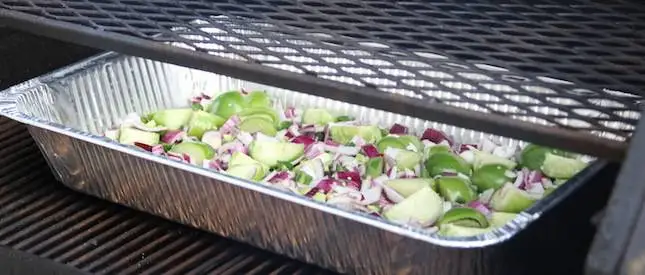
Smoke the Vegetables Alongside the Pork: The tomatillos, onion, garlic, and jalapeños go on a sheet tray at the same 250°F temperature as the pork shoulder for 45–60 minutes. This isn't a shortcut — it's the technique. Smoked tomatillos carry a depth that raw or even stovetop-roasted ones don't have, and it means the wood smoke character runs through the entire sauce rather than being limited to the meat's surface. Don't skip this step or replace it with oven-roasting.
Cut the Pork into Large Chunks Before Smoking: The recipe calls for trimming and cubing the shoulder before it goes on the grill, not smoking a whole roast and pulling it after. Large chunks — roughly 2–3 inch pieces — give you more surface area to develop bark during the smoke phase, which means more rendered-fat flavor when it breaks down into the sauce. A whole shoulder smoked then pulled would give you a different texture and less bark distribution throughout the stew.
The Dutch Oven Goes Back on the Grill: After blending the chile sauce, the smoked pork and sauce go into a Dutch oven and return to the grill at 275°F for another 2–3 hours. Keeping the cook on the grill rather than moving to a stovetop simmer continues layering ambient smoke into the open Dutch oven as it reduces. The stew thickens differently on the grill than it does on a burner — the convection heat in the pellet grill reduces the liquid more evenly without scorching the bottom.
It Freezes Exceptionally Well: Green chile stew with pork shoulder is one of the best BBQ dishes to make in quantity specifically because it freezes beautifully for up to three months. The fat in the shoulder keeps the pork from drying out through a freeze-thaw cycle, and the chile sauce actually improves slightly after freezing as the flavors continue to meld. Make a full batch, portion into quart containers, and you have a ready meal that reheats in 15 minutes on the stovetop.
Recommended Recipes