

Grilled Carnitas starts with a Boston butt pork shoulder cut into 2-inch chunks, combined in a Lodge Dutch oven with lard, Cattleman's Grill Mexicano Seasoning, hot sauce, onion, garlic, bay leaf, orange juice, and vegetable stock — then cooked uncovered at 425°F on the YS640s for about 3 hours. Cooking uncovered is deliberate: the liquid slowly reduces while the exposed pork develops a rich browned exterior, and you add more stock as needed to keep it from scorching.
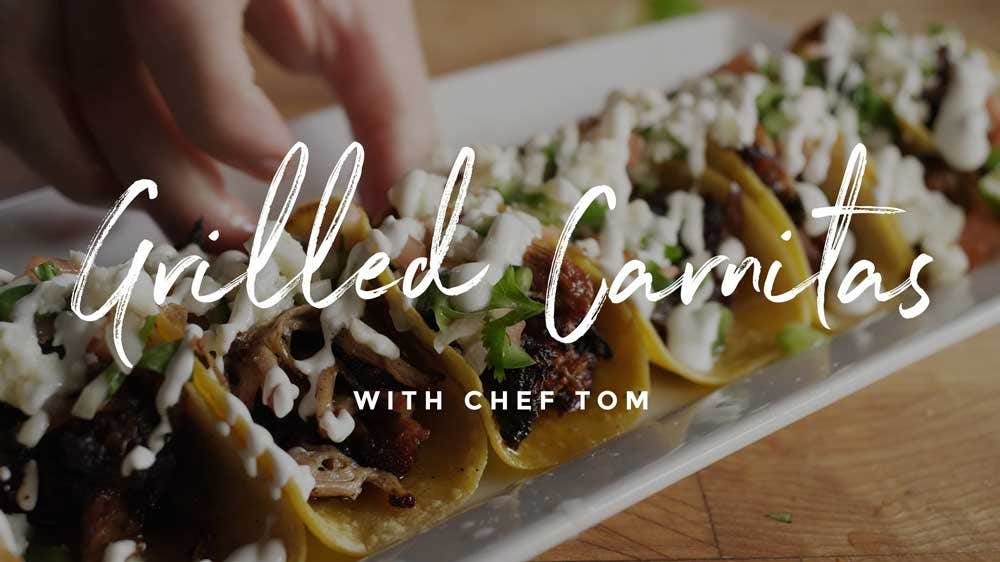
Once the pork is tender and pulls apart easily, it goes into a cast iron skillet to crisp in its own rendered fat and braising juices. The result is the defining characteristic of great carnitas — crispy, caramelized edges with juicy, tender interiors. Served in small tortillas with fresh pico de gallo, queso fresco, and crema, this recipe works equally well for tacos, burritos, rice bowls, or a breakfast scramble.
What You'll Love About This Recipe
- Lard and orange juice braise builds the authentic rich, citrusy carnitas flavor
- Uncovered cooking on the pellet grill browns the exposed pork for real texture
- Final crisping in cast iron creates those signature caramelized edges
- One Dutch oven handles the entire braise from start to finish
- Serves 12 — perfect for tacos, burritos, rice bowls, or breakfast scrambles
- Fresh pico de gallo made from scratch in the same session
Grilled Carnitas
Tom Jackson
Rated 4.8 stars by 10 users
Category
Entree
Cuisine
Mexican
Servings
12
Prep Time
30 minutes
Cook Time
3 hours 1 minute
Calories
692
If you’re looking to make tacos, burritos, rice bowls or even a breakfast scramble, then you need these Grilled Carnitas in your life! Chef Tom fires up the Yoder Smokers YS640s Pellet Grill and turns a Boston Butt pork shoulder into mouth watering Grilled Carnitas.
Ingredients
- 4 lbs Boston butt pork shoulder, diced into 2” chunks
- 1/2 cup lard
-
1/4 cup Cattleman’s Grill Mexicano Seasoning
-
2 tbsp Flavolcano Smoky Red Pepper Hot Sauce
- 1 bay leaf
- 1 yellow onion, sliced thin
- 6 cloves garlic, crushed
- juice of 2 oranges
- 4 cups vegetable stock
- 12 small tortillas
- Mexican Crema (or sour cream)
- Queso fresco
- 1/2 cup tomato, small dice
- 1/2 cup yellow onion, small dice
- 1/2 cup jalapeño, minced
- 1/4 cup cilantro, minced
- 2-3 tbsp lime juice
-
Jacobsen Salt Co. Black Garlic Salt, to taste
For the carnitas:
For the tacos:
For the Pico de Gallo:
Directions
- Preheat your Yoder Smokers YS640 Pellet Grill to 425ºF.
- Combine all carnitas ingredients, except the vegetable stock, in a Lodge Logic 6 Quart Enameled Cast Iron Dutch Oven. Mix ingredients by hand. Add just enough vegetable stock to almost cover the ingredients (3 cups).
- Place the dutch oven in the cooker, uncovered. Cook until the pork is tender enough to shred, about 3 hours.
- To make the Pico de Gallo, combine all ingredients in a small bowl and mix well. Taste and adjust seasonings as needed. Cover and store in the refrigerator for up to one week.
- Check on the pork occasionally. If/when the liquid level gets low add more vegetable stock, one cup at a time. You don’t want the liquid to cook out completely, or the bottom will scorch. However, allowing the pork to be exposed on top will nicely brown the meat.
When the pork is tender, remove from the grill.
Crisp the carnitas in their own fat and juices in a Lodge 10” Cast Iron Skillet. Place the Grilled Carnitas in tortillas with Pico de Gallo, queso fresco and cream.
Recipe Note
Recipe FAQ
Why cook the carnitas uncovered on the grill?
Cooking uncovered is what creates the characteristic carnitas texture — the liquid reduces gradually while the exposed top of the pork develops a rich, browned exterior from direct heat exposure. If you cover the Dutch oven, you're braising and steaming, which produces tender pork but none of the surface color and texture that separates carnitas from plain pulled pork. Monitor the liquid level and add stock one cup at a time as needed to prevent scorching.
Why does this recipe use lard instead of oil?
Lard is traditional to carnitas and produces a noticeably richer, more authentic result. It has a higher smoke point than most oils and renders into the braising liquid, essentially confit-cooking the pork in its own fat alongside the stock and citrus. The flavor difference is real — lard contributes a depth that vegetable oil can't replicate. If you can't find lard, rendered pork fat or duck fat are the best substitutes.
Why add orange juice to the braise?
Orange juice is a classical carnitas ingredient for two reasons: the acidity helps tenderize the pork during the long braise, and the natural sugars caramelize during cooking and contribute to the browned crust on the exposed meat. Fresh-squeezed is noticeably better here — bottled orange juice tends to taste flat and overly sweet after 3 hours of reduction.
What does crisping in cast iron do and can I skip it?
The final cast iron crisping step is what completes the carnitas. After the braise, the pork is tender but soft — the skillet is what creates those deeply caramelized, slightly crunchy edges that define the dish. Cook it in the rendered braising fat, pressing down with a spatula to maximize contact with the hot surface. Don't skip it — it's the difference between good carnitas and great ones.
Can I cook this Indoors?
We rate this a 2 out of 5 for cooking indoors. Can be done inside, but loses key flavor or texture. The Dutch oven braise can be done in a standard oven at 425°F and the final crisping works in a cast iron skillet on the stovetop. What you lose is the subtle smoke from the pellet grill and the uncovered cooking environment that helps develop the exposed browning.
Recipe Highlights & Insights
- The combination of lard, orange juice, and vegetable stock in a single Dutch oven is the classic carnitas braising formula. The lard enriches and bastes the pork from below; the orange juice tenderizes and caramelizes; the stock provides the liquid volume that keeps everything from scorching during the 3-hour cook. Each element is doing a specific job — this isn't a recipe where you can swap freely and get the same result.
- Cooking at 425°F rather than a low-and-slow temperature is intentional. Carnitas is not a low-and-slow recipe — the higher heat drives faster evaporation from the braising liquid and promotes browning on the exposed pork. The goal is tender-but-textured, not fall-apart soft. The 3-hour window at high heat gets you there.
- The final crisping step in cast iron is the most important finishing move in the recipe. After 3 hours of braising, the pork is moist and tender but uniform in texture. The screaming hot skillet with the rendered braising fat creates those caramelized, slightly crunchy edges in 2–3 minutes that make carnitas unmistakably carnitas. Press down with a spatula to maximize contact with the pan.
- This recipe serves 12 and the carnitas hold and reheat exceptionally well, making it one of the strongest batch-cook recipes in the ATBBQ catalog. Store with a little braising liquid to keep them moist, and re-crisp in a hot skillet when ready to serve. The pico de gallo made alongside keeps up to a week in the refrigerator, so the whole recipe has built-in leftover value.
Recommended Recipes
Nutrition
Nutrition
- Nutrition Serving Size
- 11.55 oz
- per serving
- Calories
- 692
- Carbs
- 31 grams
- Protein
- 40 grams
- Fat
- 44 grams
- Sodium
- 803 milligrams


